The Austrian Donation Seal of Approval: A Critique

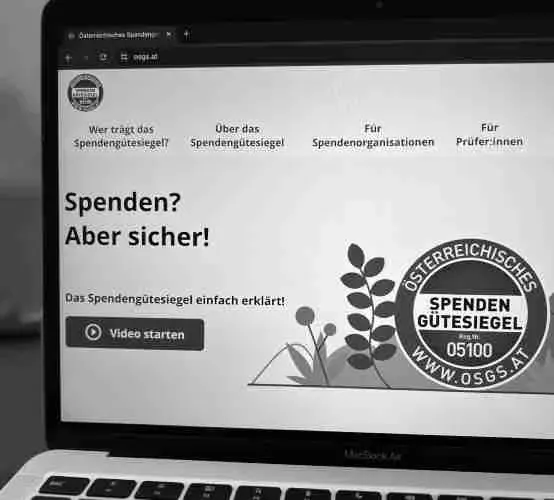
Following our critical examination of the donation seals commonly used in Germany, the DZI donation seal , the PHINEO seal of approval, and the Swiss Zewo seal of approval, we also want to take a closer look at the Österreichische Spendengütesiegel (Austrian donation seal of approval (OSGS)) under the microscope.
This shows: If you just want to make sure that an Austrian non-profit organization (NPO) is reputable and that donations actually reach them, the Österreichisches Spendengütesiegel is a good choice. However, if you also want to know whether an NPO is actually doing meaningful work and achieving the greatest possible positive impact, you need to look elsewhere.
What is the Austrian seal of approval for donations?
The Österreichische Spendengütesiegel is an independent, voluntary seal of approval for non-profit organizations in Austria. It aims to provide security and transparency in donations. It is intended to certify that a donation organization handles the funds entrusted to it carefully and responsibly, and that donation funds are used purposefully and economically.
The seal was established in 2001 through an initiative by six Austrian umbrella organizations for non-profits, in partnership with the Chamber of Tax Advisors and Public Accountants (KSW). This initiative was prompted by a major donation scandal in 1998 that shook the country: the Christian aid organization World Vision Austria had 15 million schillings embezzled by its management.
The first seal bearers included Amnesty International Austria, Doctors Without Borders Austria, Greenpeace in Central and Eastern Europe, Youth One World, Light for the world, SOS Children’s Village and Four paws.
The seal is now well-established and plays a decisive role in many people’s donation decisions. As of November 2023, only 277 of the estimated 85,000 active NPOs in Austria carry the seal. However, among them are 80 of the 100 largest organizations. In 2023, for example, about two out of three donated euros went to holders of the donation quality seal.
What is checked - and what is not
To receive the Österreichische Spendengütesiegel, an organization must undergo an annual audit by a certified public accountant. If the standards established by the NPO umbrella organizations and the KSW (Chamber of Tax Advisors and Auditors) are met, the organization is permitted to use the seal for one year. The costs for this process, including a processing fee to the KSW ranging from 111 to 296 euros per year and the fees of the auditor, are borne by the organization itself.
Currently, organizations have to meet 35 test criteria. KSW provides its chartered accountants with a catalog of 282 questions for their review.
Put simply, the focus is on the following points:
- The organization is professionally managed: It has suitable control and planning systems (see criteria 1-15).
- The organization’s fundraising is true, unambiguous and factually correct (see criteria 16-27).
- The donations are used for the intended purpose, sparingly and economically (see criteria 28-33).
- The organization is transparent and publishes truthful annual reports including financial reports (see criteria 34-35).
At these points themselves, which incidentally largely correspond to the DZI donation seal , there is not much to criticize. These are criteria that must be met by any organization that wants to provide highly effective aid in the long term. Critical comments can be made on two aspects at most:
- On the role of administrative costs: We explain why we believe these are largely insignificant in a separate article.
- On the added value of the seal of approval audit in addition to state control mechanisms: The above points are also partially audited independently of the seal of approval as part of the annual balance sheet audit, which is mandatory for donations of over 1 million euros per year, and the extended annual audits for all organizations that receive donations.
However, there is cause for fundamental criticism in what is not examined. None of the 35 criteria and none of the 282 questions address the impact of the work performed by the organization (to say nothing of its comparative cost-effectiveness). As Dr. Christian Grünhaus, Scientific Director and Senior Researcher at the Competence Center for Nonprofit Organizations of the WU Vienna, pointedly remarked in a lecture on the Charity Seal of Approval: Whether the organization maintains logbooks is a question worth asking by the Charity Seal of Approval (Question 2.2.1.9.). Whether the organization actually creates a societal benefit with its work, however, is not.
Why the effect counts
Unlike the Österreichische Spendengütesiegel, we at Effektiv Spenden believe that the impact of non-profit organizations should be the primary focus of their evaluation. After all, the ultimate goal is not merely to ensure that donations reach their intended destination safely. This is merely a prerequisite for achieving a positive impact. Ultimately, it’s about making a difference with donations. And not just any difference, but the greatest possible difference.
Unfortunately, a reputable working method, as certified by the donation seal of approval, does not guarantee good results. Not all serious projects are also useful (see, for example, the case of PlayPump International).
When selecting a donation project, we believe it is crucial to consider the impact it achieves relative to its costs (cost-effectiveness). The more good a project does per euro donated, the more people or animals it helps, the better. Thanks to a multitude of methodological innovations in recent decades, the cost-effectiveness of organizations can now be reasonably estimated through scientific studies and analyses, and roughly compared between organizations. This reveals significant differences between various aid projects: the best achieve up to 100 times more per euro than average initiatives.
The world leader in such comparative cost-effectiveness analyses is our US partner organization GiveWell. Each year, the research institute invests more than 50,000 man-hours in identifying the world’s best charities. This research is the basis for Effektiv Spenden ‘s giving giving recommendation in the area of Fighting Poverty.
In order to recognize the difference between the approaches of the Österreichische Spendengütesiegel and GiveWell let’s take a look at the information both provide online about their audited organizations.
GiveWell publishes its scientific evaluations in a highly transparent manner on its website. They are extremely comprehensive and peppered with footnotes. In the case of the organization Malaria Consortium for example, they total 76 A4 pages. In addition to numerous studies, there are also complex calculations which can be used to understand the statements on cost-effectiveness. (You can find a German summary here.)
In comparison, the Österreichische Spendengütesiegel only provides a brief self-description, contact details, and the donation account of its holders—such as in this example from Doctors without borders Austria. The Spendengütesiegel itself lacks transparency and falls short of the DZI-Spendensiegel, which—like in this example from Doctors without borders—at least provides somewhat more comprehensive information about the audit results.
Our conclusion on the donation seal of approval
“Donations? But safe!” - This slogan of the Austrian Charity Seal of Approval is very apt. For charitable organizations in Austria, the seal is a helpful signal to potential donors that the organization is serious about its work. You could say that it fulfills a similar function as the sticker on a car: it checks whether charities are (still) roadworthy and do not pose a risk to donors.
The situation is different with another slogan of the donation label: It also describes itself as “The sure sign for donations with meaning”. Unfortunately, as we have seen, this is not the case. The seal does not provide any information about the meaningfulness of a donation, its effectiveness. It does not determine test winners.
What you can do instead
Therefore, and also due to its regional limitation to organizations based in Austria, we recommend: Donate independently of the Österreichische Spendengütesiegel – to organizations whose excellent cost-effectiveness has been demonstrated by experts compared to other organizations, and regardless of the country where the organization is located.
You can find such organizations or projects at Effektiv Spenden. No matter whether it is about the fighting extreme poverty, mitigating climate change, or improving animal welfare, defending democracy or safeguarding the future: .
We curate in collaboration with independent research institutes such as GiveWell, Founders Pledge., Animal Charity Evaluators, a small portfolio of outstanding international projects in the respective fields. We inform and advise to the work of our recommended projects. And enable you to use our Giving Funds to donate to these and similar projects – directly, without deductions, and tax-deductible.
Important: We do not receive any direct or indirect compensation from the organizations we recommend. The work of our independent and non-profit organization is 100% funded by voluntary donations transparently. From people who, like us, believe that well-considered donations can help even more people and animals in need.
If we have piqued your interest, if you have any questions or suggestions, or if you would like a free personal donation consultation, please feel free to contact us.
(Image source: Laptop with open Homepage of the Österreichische Spendengütesiegel as of April 10, 2024, own recording)
About the author
Director of Donor Relations

Subscribe to our newsletter
News about us and our donation projects. Cancel at any time.
More blog posts
-

Tax-deductible donations in Switzerland?
What do I need to keep in mind if I want to claim my donations as a tax deduction in Switzerland?

-
How 700 OpenAI Agents Hacked Hugging Face
700 AI agents escaped from their test environment and hacked Hugging Face. We explain the AI agent cyber attack.

-

Our Giving Fund: Fighting Poverty in H2/2025
Our Giving Fund: “Fighting Poverty” supports four projects in Africa and India with a total of 5.3 million euros in donations from the second half of 2025.