
Poverty is on the rise again
In recent decades, nearly 1.5 billion people have been able to escape extreme poverty. Unfortunately, this trend is now beginning to reverse. The organization Our World in Data assumes that the number of people living in extreme poverty will rise from the current 832 million to 932 million by 2040.[1] This development is further exacerbated by the fact that government development cooperation is currently being cut back at record speed. After a decline of 9% was already recorded in 2024, the OECD even expects cuts of up to 17% for this year.[2]

Donating works
Donations can make an important contribution to supporting people living in extreme poverty. But the effectiveness of the charity that’s supported makes a big difference. While most people assume that there is little difference in effectiveness between charities, the best organizations are actually up to 100 times more effective than the average.[3] There are two main reasons for this:
1. Every euro achieves more in developing countries.
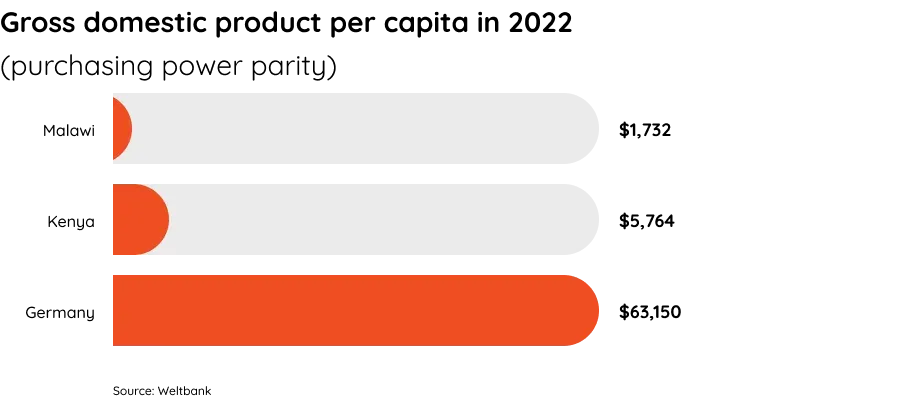
Most of us would agree that every human life has equal value. So if we want to help people, it shouldn’t matter where they live - in our neighborhood or in the Global South. But prosperity is much lower there. For example, Kenya’s gross domestic product per capita is only 9% of Germany’s. In Malawi, it is less than 3%. Because of these differences in purchasing power, the same amount of money can “automatically” do more for people in a very poor country than in a wealthy country.
As a result of this enormous wealth gap and the strong purchasing power of the euro, it is possible to rid a schoolchild of harmful parasites for less than €1 in these countries, or to distribute a mosquito net that reliably protects against malaria for less than €4. Both are measures that often save the lives of those affected, but in any case improve them, and which are fortunately no longer necessary in industrialized countries.
2. Health is not everything, but without health everything is nothing.
For example, the J-PAL Poverty Action Lab, a research institute based at the Massachusetts Institute of Technology, has compared the cost-effectiveness of various measures to increase children’s participation in school.[4] To this end, 58 randomized studies from 28 countries in Africa, Asia, and Latin America were examined.
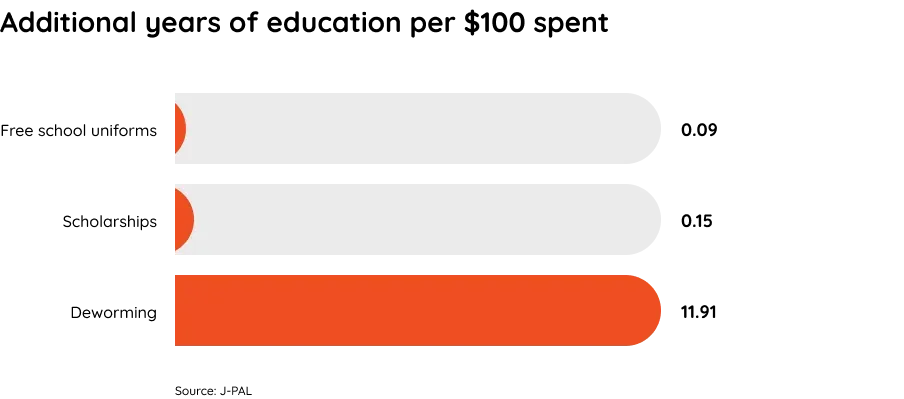
The study showed that health measures that reduce the frequency of illness among schoolchildren are among the most effective ways to increase school attendance. $100 for free school uniforms led to 0.09 additional years of school attendance in Kenya. $100 for scholarships increased school attendance by 0.15 years.
However, if the $100 were invested in school-based deworming programs, children would gain 11.9 additional years of schooling. So the same amount of money could have an impact 80 or more than 100 times greater. After all, scholarships and uniforms are of no use to those who cannot attend school because of illness.
The effectiveness is scientifically proven
So we are dealing with two very powerful levers: firstly, the purchasing power advantage of our euros in very poor countries, and secondly, the knowledge gained through scientific studies. If we combine the two, we can increase the impact of our donation 100-fold.
This is made possible in particular by systematic research in the field of development economics. Three economists, Esther Duflo, Abhijit Banerjee and Michael Kremer, were even awarded the 2019 Nobel Memorial Prize in Economic Sciences for their work on the effectiveness of different approaches in development cooperation.[5]
Based on their research and a variety of other studies, renowned research institutes such as GiveWell examine both aid measures and individual aid organizations in terms of their effectiveness and cost-effectiveness. We base our recommendations on these studies.
Giving Fund: Fighting Poverty
We recommend our Giving Fund: Fighting Poverty as the most flexible and easiest way to support the most promising aid organisations. Our fund is modelled on the “All Grants Fund” of the renowned research institute GiveWell. Learn more
Charities recommended by us
The charities we recommend have been extensively reviewed for their effectiveness and cost efficiency and have a proven track-record. Our first four recommendations are the current GiveWell “Top Charities”. We also recommend two other highly effective charities that were GiveWell “Top Charities” in the past.
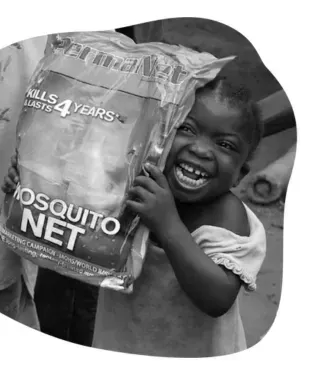
Against Malaria Foundation
More than 1,000 children die of malaria every day. The Against Malaria Foundation distributes mosquito nets in developing countries with great success. For just around $5, a mosquito net protects 2 people from malaria for 2 years. Learn more


Helen Keller Intl
Millions of children have died or gone blind in recent decades as a result of vitamin A deficiency. Helen Keller Intl supports government mass distribution programmes and can provide an at-risk child with a high-dose vitamin A capsule for $1. Learn more
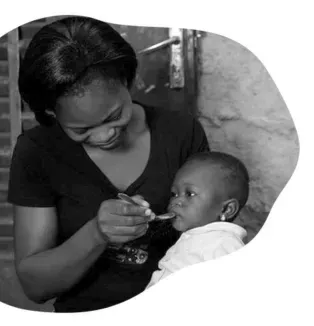

Malaria Consortium
More than 1,000 children die of malaria every day. Malaria Consortium saves lives with preventative medication. For less than $6, a child in southern Africa can be protected for the entire rainy season. Learn more
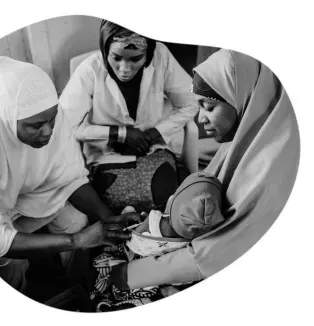

New Incentives
Vaccinations against diseases such as diphtheria, measles, and tuberculosis are considered among the most cost-effective health interventions. By providing families in North West Nigeria with small cash incentives of up to 11,000 Naira, New Incentives has managed to double local vaccination rates. Learn more


Deworm the World
More than one billion people are infected with parasites and worms. Deworm the World runs deworming programs for children worldwide. For just $1, a child can be protected from worms for a whole year. Learn more
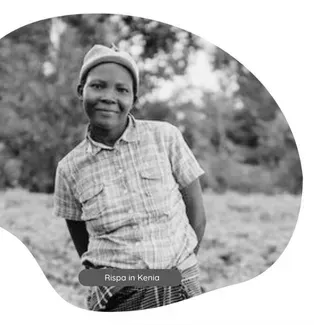

GiveDirectly.
There are still more than 800 million people living in extreme poverty. GiveDirectly supports very poor people through direct & unconditional cash transfers. Studies show that this is a particularly sustainable way of overcoming extreme poverty. Learn more
Your personal advice
Those who donate want to make a difference. We are happy to help you achieve the greatest possible impact in line with your ideas and values. Simply make an appointment for your personal consultation.
Anne Schulze,
Founder & Managing Director





FAQs
How much should I donate?
How much you donate is, of course, entirely your own decision. You may find some inspiration in our articles “How much should I donate?” and “Why and how I donate”.
Can I deduct my donation from my taxes?
Yes, you can deduct your donation from your taxes in Germany and Switzerland, even if the organizations we recommend are based abroad. We automatically email you one donation receipt for all your donations at the end of February of the following year. You don’t need to do anything. Once it has been issued, you will also find it as a PDF in your donor account.
I don’t want to donate online. Can I pay by bank transfer instead?
Of course, you’re welcome to donate by bank transfer. In our donation form, choose “Bank transfer” as the payment method, enter the details we need for your donation receipt, and register your donation. You’ll then receive an email with our bank details and a payment reference, which lets us match your transfer to your donation once it arrives.
What fees apply? Do you pass on 100% of my donation?
We process donations free of charge, so we keep nothing of your donation for ourselves. However, the payment providers we work with charge fees, for example for credit card or PayPal payments. They depend on the payment method you choose and are as follows for Germany:
- Bank transfer: free within the SEPA area
- SEPA direct debit: €0.35
- Credit card: 1.2% + €0.25 (for European cards)
- PayPal: 1.5% + €0.35
For amounts up to €10,000, we therefore recommend SEPA direct debit, which is particularly easy for us to process. For security reasons, amounts of €10,000 or more can currently only be donated by bank transfer.
You would pay similar fees if you donated to the organizations directly. We have negotiated with all payment providers and get particularly favorable terms for non-profits.
We fund our own work through donations too, completely separately. You can read more about this on our transparency page.
How can I change, pause or cancel my recurring donation?
Log in to your donor account. There you can change the amount or how it is split, pause your recurring donation or cancel it at any time, without giving a reason.
Do you donate by standing order? Then the payment runs through your bank, so you can only change the amount, pause or cancel there, by adjusting, suspending or deleting the standing order. Please still let us know in your donor account if you change the amount or cancel. Otherwise you will receive an automated payment reminder, which you can simply ignore.
Prefer email or phone? We’re still here for you: info@effektiv-spenden.org (🇩🇪 +49 30 260 355 19, 🇨🇭 +41 44 244 27 38, 🇦🇹 +43 1 266 01 38).
How do you cover your costs?
Effektiv Spenden is made possible by private funders, whose support covers all of our administrative costs. This allows us to pass on your donation to our top organizations in full. Of course, we also welcome donations to us as a platform. You can find out more about how we are funded on our transparency page.
Sources
[1] ↑ The end of progress against extreme poverty? Our World in Data. https://ourworldindata.org/end-progress-extreme-povertyNovember 2025.
[2] ↑ Cuts in official development assistance. OECD. https://www.oecd.org/en/publications/cuts-in-official-development-assistance_8c530629-en/full-report.htmlJune 2025.
[3] ↑ Lucius Caviola et. al. Donors vastly underestimate differences in charities' effectiveness. Judgment and Decision Making, Vol. 15, No. 4. https://journal.sjdm.org/20/200504/jdm200504.pdf. October 2021.
[4] ↑ Deworming to increase school attendance. J-PAL. https://www.povertyactionlab.org/case-study/deworming-increase-school-attendance. February 2020. See also Roll Call: Getting Children into School. J-PAL Policy Bulletin. https://www.povertyactionlab.org/sites/default/files/publication/roll-call-getting-children-into-school.pdf. August 2017.
[5] ↑ Wirtschaftsnobelpreis geht an Armutsforscher. ARD alpha. https://www.ardalpha.de/wissen/nobelpreis/nobelpreis-2019-wirtschaftsnobelpreis-wirtschaft-100.html. October 2019.