How best to help animals
Although meat consumption in Germany is declining, almost 750 million animals died for food production in Germany alone in 2024.[1] Most of these animals are raised in inappropriate, cruel conditions on factory farms. Organic meat, for example, still only represents a niche market with a share of less than 4%. [2]
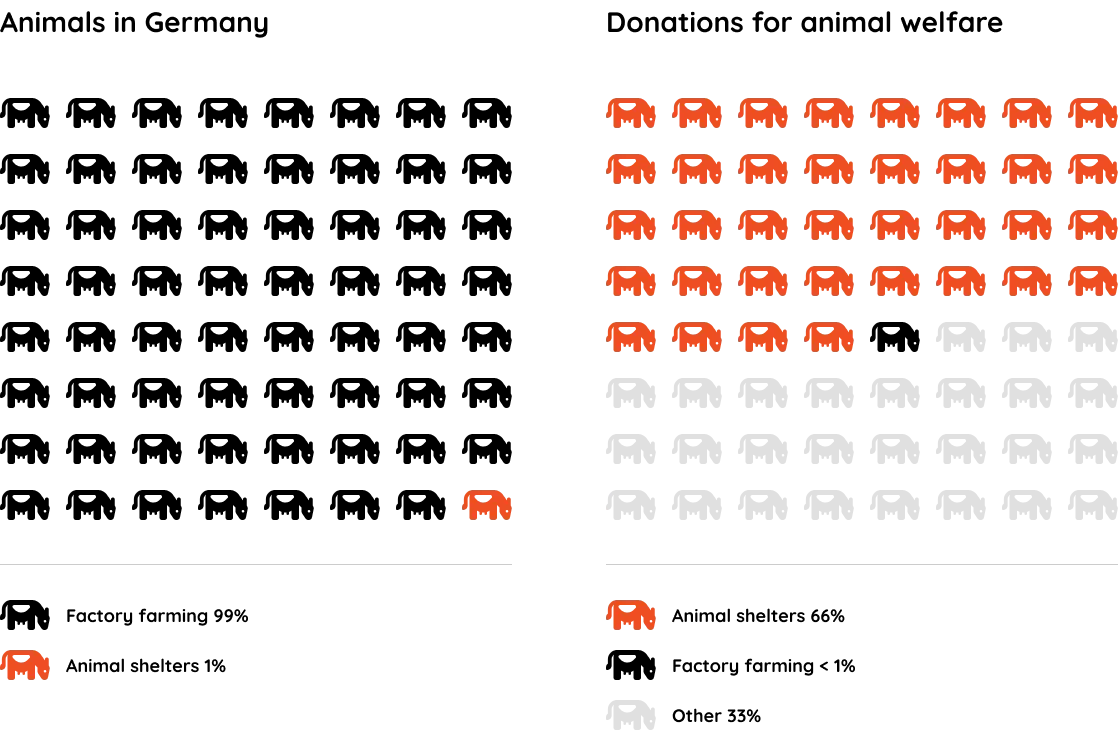
By way of comparison, according to projections, around 350,000 animals are taken into animal shelters in Germany every year.[3] Therefore, more than 2,000 (two thousand!) times as many animals are slaughtered each year in factory farms than are admitted to animal shelters.
The situation is similar in other countries. Worldwide, more than 80 billion farm animals slaughtered (and the trend is rising), many times the number of domestic animals kept worldwide.[4] [5]

Farm animals don’t have a lobby
Nevertheless, most people tend to focus on pets. While the law prescribes an area of between 6-10 square meters for keeping dogs in enclosures, for example,[6] pigs weighing significantly more than 100 kg at the time of slaughter must make do with less than one square meter.
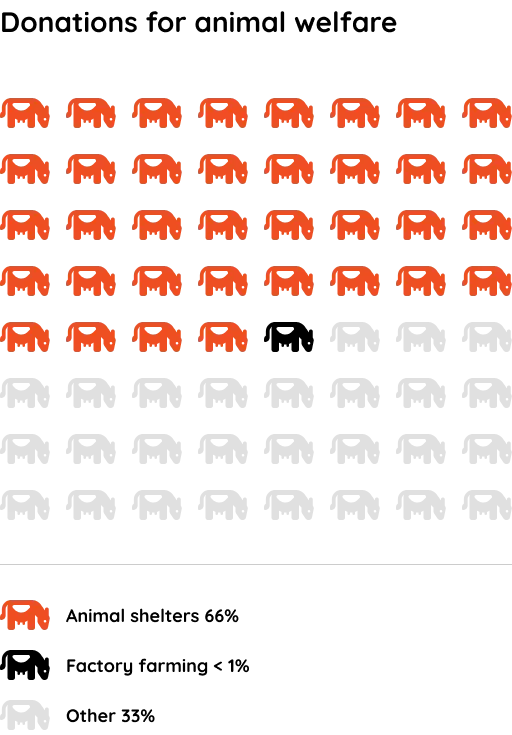
The focus of many people on the welfare of pets is also reflected in the volume of donations: In the US, for example, only 0.8% of donations go to organizations that focus on reducing the suffering of farm animals. (Similar figures are unfortunately not available for Germany.) For every animal in an animal shelter, around $500 are donated, while only around 0.2 US cents are donated for every animal in factory farms!
The leverage is great
This means that donations are not going where they are most needed to help the most animals. For example, it costs more than $1,000 per year to house an animal in a shelter. With the same amount of money, a highly effective farm animal welfare organization can accomplish much more. For example, The Humane League would use the $1,000 to engage in dialogue with companies to improve conditions for farmed animals, to convince people to reduce their meat consumption, or to conduct research. According to independent analysis, The Humane League thereby improves the lives of thousands of animals instead of just one.
More than just animal suffering
In addition to alleviating billions of cases of animal suffering, there are other reasons to advocate for a reduction in the consumption of animal products worldwide. For example, animal agriculture is responsible for over 10% of global greenhouse gas emissions.
In addition, industrial livestock farming is responsible for enormous water consumption, contributes to the contamination of groundwater through the production of liquid manure and accelerates the development of multi-resistant germs through the excessive use of antibiotics.
Giving Fund: Improving Animal Welfare

We recommend our Giving Fund: Improving Animal Welfare as the most flexible and easiest way to support the most promising animal welfare organisations. Our fund is modelled on the recommendations of the “EA Animal Welfare Fund”. Learn more
Charities recommended by us
There are also considerable differences in the effectiveness of charitable organizations when it comes to animal welfare. The work of the organizations we recommend has therefore been comprehensively examined by independent experts such as Animal Charity Evaluators (ACE) and rated as particularly effective in an international comparison.
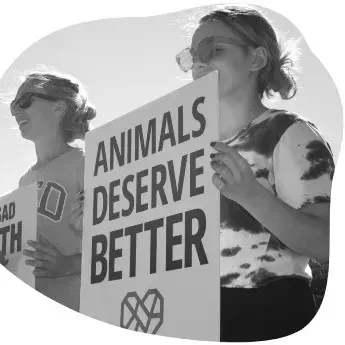

The Humane League
With the goal of ending the mistreatment of animals for food production, The Humane League successfully pressures companies to adopt higher animal welfare standards through its international branches in all major markets around the world. Learn more
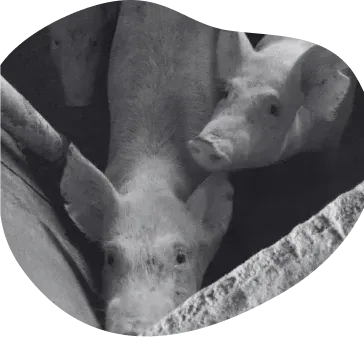

Sinergia Animal
Sinergia Animal is an international animal protection organization operating in countries of the Global South. Through intensive campaigns, corporate partnerships, and consumer education, Sinergia Animal reduces the suffering of ~53 animals per dollar donated. Learn more
In addition, we recommend the organization Good Food Institute (GFI), which is committed to developing and promoting healthy and tasty alternatives to conventional meat. However, we now carry these in the Mitigating Climate Changeas the current situation present evaluation Our research partner Giving Green focuses entirely on this area.
Your personal advice
Those who donate want to make a difference. We are happy to help you achieve the greatest possible impact in line with your ideas and values. Simply make an appointment for your personal consultation.
Anne Schulze,
Founder & Managing Director
Blog articles




FAQs
How much should I donate?
How much you want to donate is of course ultimately your own personal decision, but perhaps you will find something in the article "How much should I donate?" and "Why and how I donate".
Can I deduct my donation from my taxes?
Yes, your donation is tax-deductible in Germany and Switzerland, even if the recommended organizations are based abroad. We will automatically send you a donation receipt for all your donations by e-mail at the end of February of the following year. You don't have to do anything else.
I don't want to donate online, can I also transfer the money?
You are also welcome to make your donation by traditional bank transfer. To do so, please use our donation form under "Payment method", select the "Bank transfer" tab, enter the details we need for the donation receipt and register your donation. You will then receive an e-mail with our donation account and a reference that will enable us to allocate your donation correctly as soon as you have transferred the donation.
What are the fees? Will you forward 100% of my donation?
We process donations free of charge, i.e. we do not keep any of your donation for ourselves. However, credit card or PayPal fees are charged by the payment providers we work with. These depend on the chosen payment method and are calculated as follows for Germany:
- Bank transfer: free of charge within the SEPA payment area
- SEPA-direct debit: 0,35 €
- Credit card: 1.2% + 0.25 € (for European cards)
- PayPal: 1,5% + 0,35 €
Therefore, for donations with amounts < 10,000 euros, we recommend Therefore, for donations of up to €10,000, we use the particularly easy-to-process SEPA-direct debit. For amounts of €10,000 or more, for security reasons, the only option currently available is Bank transfer will be available.
Comparable fees would also be incurred for a direct donation to the respective organizations. We have already negotiated with all payment providers and obtained particularly favorable conditions for non-profit organizations.
We also finance ourselves through donations, but completely independently.
You can find out more here.
How can I change or cancel my recurring donation?
If you would like to increase or decrease the amount of your donation, simply send us an email. info@effektiv-spenden.org with us. We are also happy to change the organizations/projects/funds you donate to if you wish. Unfortunately, we cannot change payment methods without further ado. To do so, you will need to cancel your donation and then set it up again.
You can cancel your recurring donation at any time without giving a reason. Simply send us an informal email to info@effektiv-spenden.org or call us at +49 (0)30 / 260 355 19.
How do you cover your costs?
Effektiv Spenden is made possible by private sponsors. This support enables us to cover all administrative costs. This allows us to pass on your donation in full to our top organizations. Of course, we also appreciate your donation to us as a platform. You can find out more about our funding here.
Sources
[1] ↑ Fewer animals slaughtered but more meat consumption in 2024. Albert Schweitzer Foundation. https://albert-schweitzer-stiftung.de/aktuell/schlachtzahlen-fleischverzehr. May 2025.
[2] ↑ How has the market share of organic meat developed? Federal Information Center for Agriculture. https://www.landwirtschaft.de/infothek/infografiken/uebersicht-aller-infografiken/wie-hat-sich-der-marktanteil-von-biofleisch-entwickelt. 2023.
[3] ↑ Registered animals are coming home! German Animal Welfare Association. https://www.tierschutzbund.de/ueber-uns/aktuelles/presse/meldung/registrierte-tiere-kommen-nach-hause/. September 2022.
[4] ↑ The figure does not include fish and seafood. See also Animal Welfare Explorer. Our World in Data. https://ourworldindata.org/explorers/animal-welfare.
[5] ↑ Exact figures for pets are not available. It is estimated that there are over 1 billion pets. (See e.g. Global Trends in the Pet Population. Health for Animals. https://www.healthforanimals.org/reports/pet-care-report/global-trends-in-the-pet-population/. September 2022). It should be noted that only a very small proportion of these are taken in by animal shelters.
[6] ↑ Animal Welfare Dog Ordinance (Tierschutz-Hundeverordnung), §6, Federal Office of Justice. https://www.gesetze-im-internet.de/tierschhuv/BJNR083800001.html. May 2001.
[7] ↑ 12% of anthropogenic greenhouse gas emissions based on the reference year 2015. Pathways towards lower emissions: A global assessment of the greenhouse gas emissions and mitigation options from livestock agrifood systems. Food and Agriculture Organization of the United Nations (FAO). https://doi.org/10.4060/cc9029en. December 2023. See also Food production is responsible for one-quarter of the world's greenhouse gas emissions. Our World in Data. https://ourworldindata.org/food-ghg-emissions. November 2019.