
Dangerous times for democracy
For years, we have been observing a very dangerous trend: from around the year 2000 - and accelerated from 2015 - the worldwide spread and deepening of democracy came to a temporary end. Instead, a mostly gradual, but sometimes rapid relapse into illiberal or autocratic forms of government set in.
According to the renowned Regimes of the World classification system, approximately 17% of the world’s population lived in a “liberal democracy” in 2004. This term refers to highly developed democracies that comprehensively protect civil liberties and uphold the rule of law. One example is the political system that was established in West Germany after the Second World War and, following reunification, across Germany as a whole—enabling a previously almost unimaginable degree of freedom, peace, security, and prosperity ever since. By 2025, only just under 8% of the world’s population still lived in such liberal democracies.
The proportion of the population that still lived in what is known as an “electoral democracy”—a form of democracy in which the rights and freedoms that people in Germany or Switzerland take for granted, institutions, and processes are now only available to a limited extent—declined from 33% in 2004 to just 19% by 2024. Since 2025, the United States have also been classified in this category, having previously been classified as a “liberal democracy” for over 50 years.
Setbacks in the middle of Europe
The example of the rapid shift toward autocracy in the United States under the second Trump administration—a pace unprecedented in U.S. history—is certainly particularly striking and alarming: According to the V-Dem Institute, it had fallen back to the development level of 1965 by 2025.
But even in Europe, there have been numerous setbacks for years, along with a widespread erosion of civil liberties and democratic institutions:
- For some time now, scholars have no longer classified Hungary and Serbia as democracies—they are what are known as “electoral autocracies.” These are countries under autocratic leadership with mostly very unfair electoral systems designed to maintain the appearance of a democratic constitution while massively favoring incumbents. Thanks to the surprisingly successful defeat of the Fidesz party in the 2026 parliamentary elections, there is now, for the first time after 16 years of democratic decline, hope for improvement in Hungary.
- In recent years, several European countries have slipped back into the category of “electoral democracy,” including Greece, Poland, Portugal, the United Kingdom, Slovakia, and Slovenia. Poland has been striving since 2023 to return to the ranks of liberal democracies, though the results of the June 2025 presidential election have made this significantly more difficult.
- Although various other countries are still classified as liberal or electoral democracies in retrospect based on scientific data collection, they have right-wing populist or far-right parties participating in government that are constantly working toward the autocratization of these countries: This applies to Finland, Italy, Croatia, Slovakia, and (indirectly) Sweden as well. Only the Netherlands has been able to reverse this trend in the recent past.
That even Germany is at risk was made clear to a broad public by the publication of the CORRECTIV investigation “Secret Plan Against Germany” on January 10, 2024. And at the latest, the results of the EU, state, and federal elections in 2024/25 have now shown that participation of extremist, illiberal forces in governments is no longer unthinkable in Germany.
How devastating the effects of such developments can be - also purely instrumentally on other topics such as Global poverty reduction or Climate Action – has become strikingly clear in the U.S. since early 2025. The criminalization of USAID and its staff, as well as the partial suspension—in some cases illegal—of large portions of U.S. development aid makes it clear, for example, that effective measures to strengthen democratic institutions in the USA may have contributed more to global poverty reduction than many direct development policy approaches.
Defending democracy effectively
Donations can make an important contribution to defending and strengthening democracies worldwide. The decision of which organization you donate to can make a big difference (often by a factor of up to 100 or more). Our goal at Effektiv Spenden is to make such effective giving as easy as possible. We therefore need to answer the key questions of effective giving for the field of democracy as well:
Where are the greatest threats to democracy - or the greatest opportunities for strengthening it? Which pro-democracy measures are particularly effective? Which organizations are particularly successful and efficient in implementing these measures? In short: Where can we achieve the most with pro-democracy donations?
These questions are at the heart of the research institute’s work Power for Democracies. Having launched operations in 2024, Power for Democracies reached the initial recommendations published, focusing on particularly effective organizations dedicated to defending democracy in Turkey, Argentina, Italy, and the United States. Indonesia followed in April 2026. We look forward to a growing international portfolio of recommendations. Power for Democracies also plans to conduct special analyses, for example on the far-reaching impacts of artificial intelligence on democracy.
You can learn more about the work of Power for Democracies in the guest article their Managing Director Markus N. Beeko in our blog.
Giving Fund: Defending Democracy
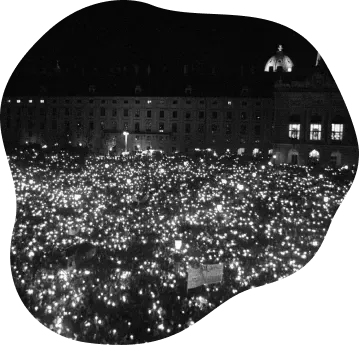

Our Giving Fund: Defending Democracy aims to support particularly promising initiatives that strengthen the resilience and effectiveness of democracy worldwide.
Launched in February 2024 as a beta version—limited to initiatives in Germany—the fund has been available as a fully developed, regular offering since August 2025.
In Switzerland—as in other areas—donations received are used to directly support recipient organizations, in accordance with the evaluator’s recommendations Power for Democracies. In Germany, the nonprofit organization specializing in international aid Common Good Fund Germany (CGFG) is the recipient. It decides independently how to use the funds—but does so in accordance with the recommendations of Power for Democracies.
Up to 20% of the fund’s assets may be used to support Power for Democracies, as this research institute—unlike established evaluators such as GiveWell or Founders Pledge—does not yet have a sustainable funding base.
Like any such organization, CGFG is entitled to use a small portion of its funds (up to 4%; currently agreed upon at 2.5%) for its day-to-day operations, such as significant legal expenses.
The Fund is managed by Stephan Schwahlen. Stephan has been advising major donors on their grant decisions since 2018, particularly in the area of defending democracy, and is also a non-operational co-founder of Power for Democracies.
Whom have we supported so far?
Allocation of funds from H2/2025
- Center for Legal and Social Studies (158,000 EUR): Argentina's A leading civil society organization dedicated to strategic litigation in the service of democracy. CELS defends civil rights and democratic institutions, fights for justice in cases of state-sponsored crimes, and protects vulnerable minorities.
- Media and Law Studies Association (205,000 EUR): The leading civil society organization of the Turkey in the area of strategic litigation for freedom of the press and freedom of expression. MLSA pursues its mission through targeted legal representation, strategic litigation, comprehensive monitoring of court proceedings, international advocacy, and legal training for attorneys and journalists on the workings of the European Court of Human Rights.
- Associazione Antigone Onlus (400,000 EUR): One of Italy’s leading civil society organizations with over three decades of experience in the fields of human rights and constitutional democracy. Antigone combines legal expertise with public advocacy: It has brought landmark cases before the Constitutional Court and the European Court of Human Rights, contributed expert opinions to parliamentary debates, and co-organized the “No DDL Sicurezza” coalition.
Read here .
Allocation of funds from H1/2025
- HateAid (100,000 euros): Base funding for 2026. We continue to see an urgent need for action to defend and enforce the Digital Services Act and the AI Act in order to safeguard fundamental rights in the digital space.
- Constitution blog (100,000 euros): Basic funding for 2026. The organization's work continues to be important, urgent and unique: for example, in the Justice project examines where the judicial branch in Germany could be targeted by enemies of the constitution—at the federal and state levels.
- Flow Fund for Eastern Germany (30,000 euros): Funding for a spot in the second cohort of this project, led by the Schöpflin Foundation and the Kinnings Foundation.
- Alliance4Europe (105,000 euros): Core funding for 2026. Alliance4Europe was founded in 2018 as a non-profit limited liability company (gGmbH) based in Munich and has, in recent years, increasingly focused on promoting and defending a pro-democratic, digitalized European society.
Read here .
Allocation of funds from Q4/2024
- HateAid (€377,000): Funding for legal aid, strategic lawsuits such as “Künast vs. Meta,” and the enforcement of the Digital Services Act to protect digital fundamental rights.
- RAA Sachsen (€50,000): Financial rescue of the democracy project “Peerleadership Saxony,” which trains young people to become multipliers in the fight against discrimination.
- Gesellschaft für Freiheitsrechte (GFF) (€150,000): Support for advisory services on nonprofit status and political neutrality, as well as strengthening the “Gegenrechtsschutz” project to combat legal abuse by anti-democratic actors.
The funds were disbursed to the organization in April 2025. Read here .
Allocation of funds from Q3/2024
- Verfassungsblog gGmbH (~54.000 €): Civil defense
The funds were disbursed to the organization in December 2024. Read here .
Allocation of funds from Q2/2024
- CORRECTIV – Recherchen für die Gesellschaft gGmbH (102.000 €): Independent, investigative journalism
- Demokratie-Stiftung (democracy foundation) campact (56.000 €): Democratic shaping of progress
- Flow Fund for Eastern Germany (35.000 €): Innovative promotion of pro-democratic civil society in Saxony-Anhalt, Thuringia, Brandenburg
- #ReclaimTikTok (50.000 €): Project against the AfD's media dominance on the platform
The funds were disbursed to the organizations in August 2024. Read here .
Allocation of funds from Q1/2024
- CORRECTIV – Recherchen für die Gesellschaft gGmbH (~55.000 €): Independent, investigative journalism
- Demokratie-Stiftung (democracy foundation) campact (~55.000 €): Democratic shaping of progress
- HateAid gGmbH (~55.000 €): Democratic participation in the digital world
The funds were disbursed to the organizations in April 2024. Read here .
Your personal advice
Those who donate want to make a difference. We are happy to help you achieve the greatest possible impact in line with your ideas and values. Simply make an appointment for your personal consultation.
Anne Schulze,
Founder & Managing Director

FAQs
How much should I donate?
How much you want to donate is of course ultimately your own personal decision, but perhaps you will find something in the article "How much should I donate?" and "Why and how I donate".
Can I deduct my donation from my taxes?
Yes, your donation is tax-deductible in Germany, Austria, Czechia and Switzerland.
However, it is important that you actually donate to our respective local branch (to our non-profit GmbH in Berlin, our non-profit association in Basel or our non-profit association in Vienna). You can recognize this by the flag at the top right of the donation form and, if paying by bank transfer, by the bank details (except for the Czech Republic).
In Austria we are currently focusing entirely on our donation funds (with the exception of Democracy and AI). Donations to specific individual organizations are currently not possible here. Do you have any questions or feedback? Please write to us at oesterreich@effektiv-spenden.org.
I don't want to donate online, can I also transfer the money?
You are also welcome to make a traditional bank transfer. Please use our donation form under "Payment method", select the "Bank transfer" tab, enter the details we need for the donation receipt and register your donation. You will then receive an e-mail with our donation account and a reference that will enable us to allocate your donation correctly as soon as you have transferred the donation.
What are the fees in Germany? Will you forward 100% of my donation?
We process donations free of charge, i.e. we do not keep any of your donation for ourselves. However, credit card or PayPal fees are charged by the payment providers we work with. These depend on the chosen payment method and are calculated as follows for Germany:
- Bank transfer: Free of charge within the SEPA payment area
- SEPA-direct debit: 0.35 Euro
- PayPal: 1.5% + 0.35 Euro
- Credit card1.2% + 0.25 Euro for European cards except Amex (2.9% + 0.25 Euro for Amex and international cards)
Therefore, for donations with amounts < 10,000 euros, we recommend For donations with amounts < 10,000 euros, we use the particularly easy to process SEPA-direct debit and for amounts > 10,000 euros the free of charge Bank transfer. For security reasons, we only offer direct debit payments < 10,000 euros, as PayPal and credit card are not recommended for high amounts for cost reasons.
Comparable fees would also be incurred for a direct donation to the respective organizations. We have already negotiated with all payment providers and obtained particularly favorable conditions for non-profit organizations.
We also finance ourselves through donations, but completely independently.
You can find out more here.
How can I change or cancel my recurring donation?
If you want to increase or decrease the amount of your donation, simply contact us by e-mail info@effektiv-spenden.org with us. We are also happy to change the organizations/projects/funds you donate to if you wish. Unfortunately, we cannot change payment methods without further ado. To do so, you will need to cancel your donation and then set it up again.
You can cancel your recurring donation at any time and without giving reasons. Simply send us an informal e-mail to info@effektiv-spenden.org or call us at +49 (0)30 / 260 355 19.
How do you cover your costs?
Effektiv Spenden is made possible by private sponsors. This support enables us to cover all administrative costs. This allows us to pass on your donation in full to our top organizations. Of course, we also appreciate your donation to us as a platform. You can find out more about our funding here.