The best solutions are many times more effective than others

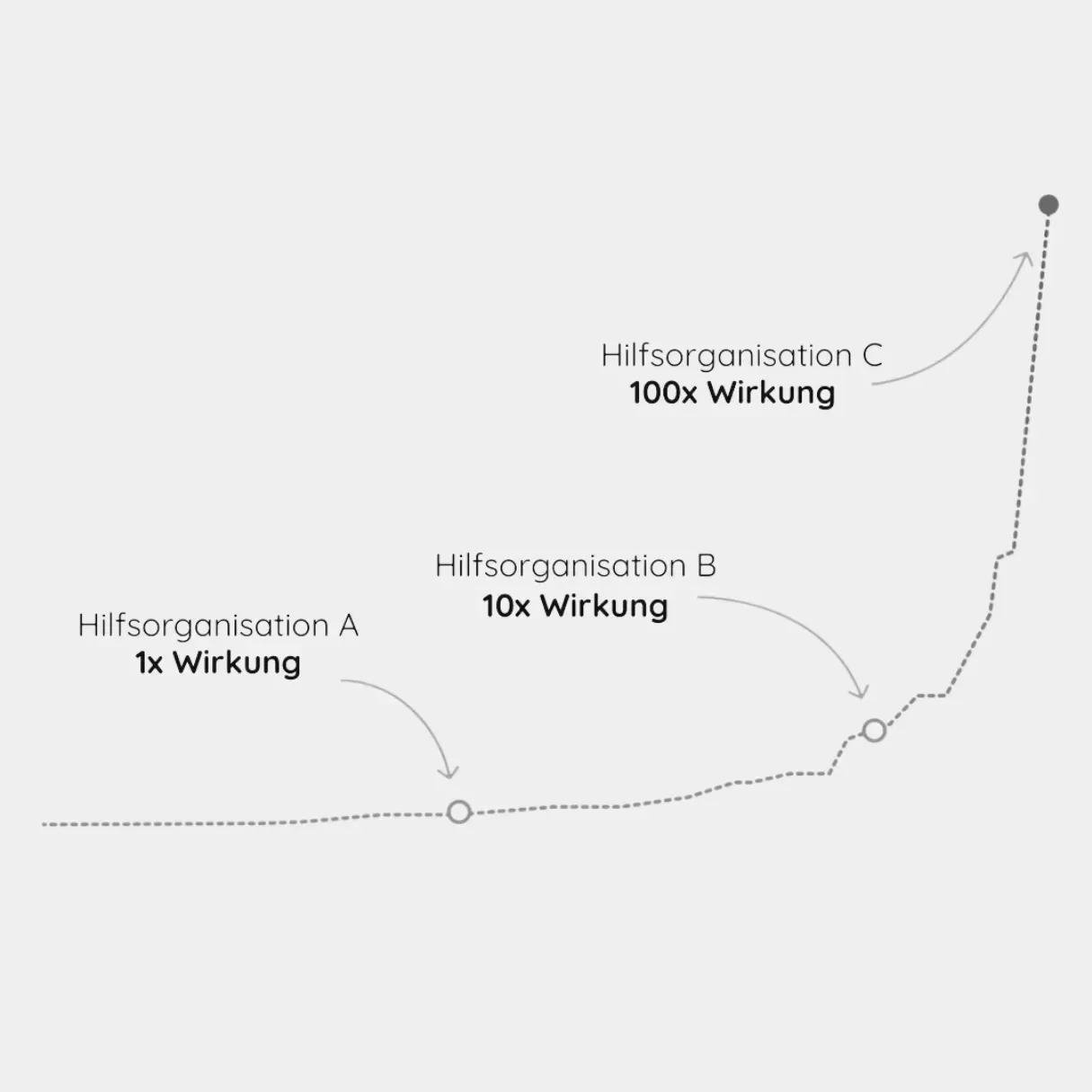
A consultant is commissioned by the main sponsors of a non-profit organization in the German social sector to evaluate the organization’s work. It quickly becomes clear that the work is basically useful, but very expensive. The impact of the work becomes particularly clear through the evaluation of a second organization that pursues a very similar approach. This second organization also reaches a similar number of people - and with only a tenth of the costs.
The sponsors then make the difficult decision to close the organization they had supported. In order to maintain the impact and reach as many people as before, they instead support the second organization with the required 10% of the funds originally spent. With the 90% now freed up, they support other worthy projects. As a result, they have multiplied the impact of their donations with the same budget.
This example is not made up, but describes how Stefan, one of our founders, was already confronted with the question of how to achieve as much as possible with donations more than ten years ago as a consultant. His experience is not an isolated case: studies show that the best organizations and measures are significantly more cost-effective than the average - often many times over.
So if we donate to those charities that have a proven track record of successfully implementing highly effective solutions, we can increase the impact of our donation by a factor of ten to a hundred and thus “multiply” our donation budget.
How much do the solutions differ in their impact?
As early as 2013, Toby Ord wrote the article “The Moral Imperative towards Cost-Effectiveness in Global Health” and pointed out the major differences in the area of global health. Ord examined measures from the publicly accessible data set “Disease Control Priorities in Developing Countries (second edition - DCP2)” the World Bank for their cost efficiency. In DCP2, 108 measures in low-income countries were compared, ranging from surgical interventions, vaccines and mosquito nets to public health programs such as the free distribution of condoms for AIDS prevention. Ord examined how many healthy life-years (disability-adjusted life-years, DALY) were gained per $1,000 invested.
His analyses show that the most cost-effective measure was around 15,000 (!) times more cost-effective than the least cost-effective. The best 2.5% of measures were about 50 times more cost-effective than the median and 23 times more cost-effective than the mean. This means that for every $1,000 invested, they contributed 50 times more disability-adjusted life-years (DALYs) than the median (and 23 times more than the mean). (The differences are so enormous that it is worth reading the above paragraph twice to visualize them)
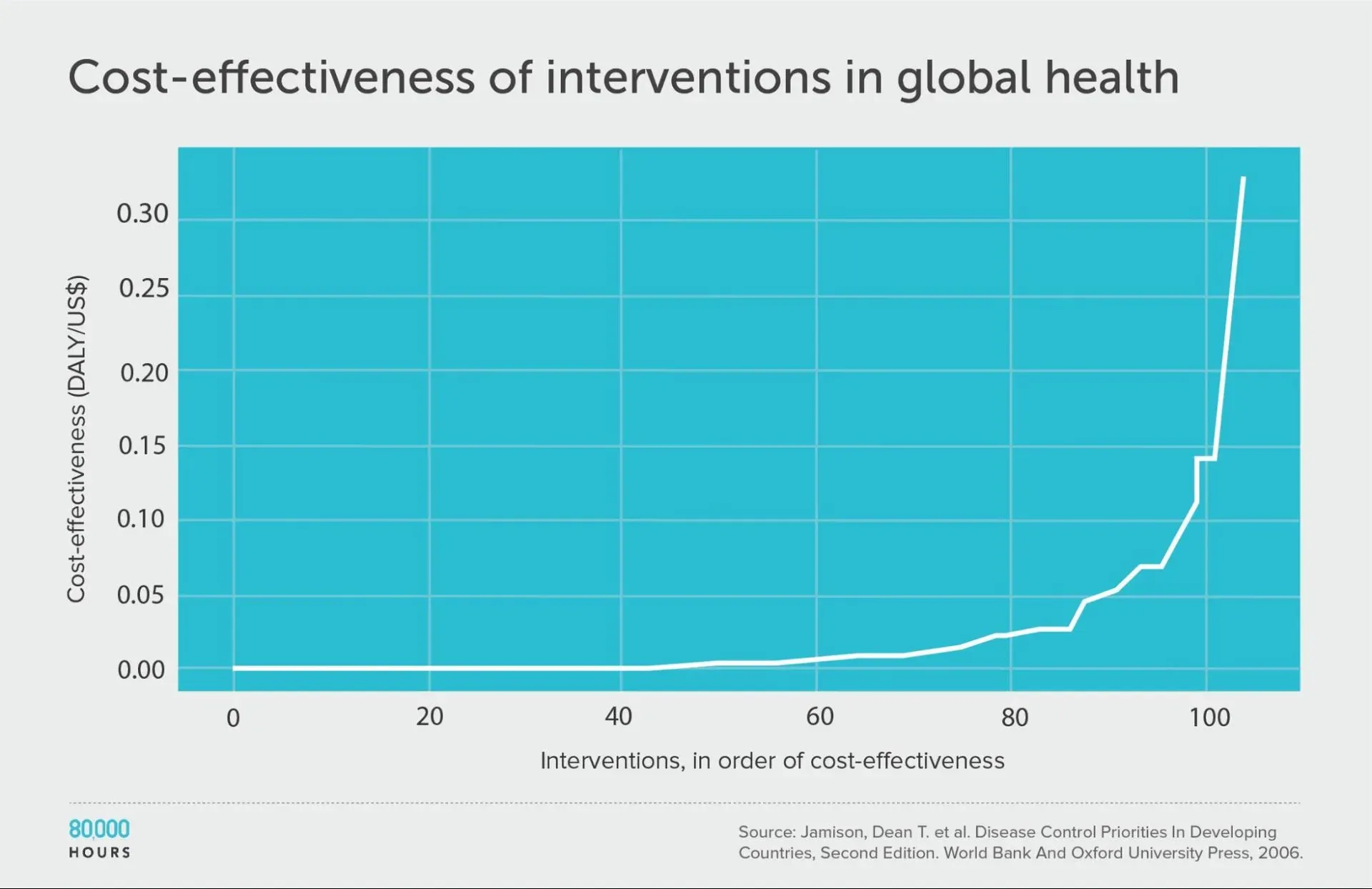
The most effective interventions therefore generated a disproportionately high share of the overall benefit. If all measures of the DCP2-study were financed in equal parts, 80% of the benefit would be achieved by the 20% most cost-effective measures. If an average measure from DCP2 is selected instead of one of the most cost-effective, then more than 90% of the potential benefit that the most cost-effective measures could have achieved with the same resources is lost.
Recently, Benjamin Todd from the organization 80,000 hours examined, whether this effect can also be found in other data sets. To this end, he looked at a wide range of measures and subject areas, including the more recent DCP3-study, WHO-CHOICE-data, health measures in the UK and social policy in the U.S., but also a renowned study on the cost-effectiveness of climate protection measures and data from the education sector. Again, the same huge differences: the best 2.5% of measures in all data sets were around 20 to 200 times more cost-effective than the median and around 8 to 20 times more cost-effective than the average.
Todd conservatively concludes that the differences may actually be smaller than his results suggest. For example, it could be that the best interventions already no longer require funding and therefore the best available interventions are somewhat less effective than the interventions studied. In addition, the data is generally retrospective and possibly too optimistic for the future. Finally, all analyses are based on assumptions that inevitably cannot perfectly reflect reality. This often leads to good results looking even better than they actually are, and bad results looking even worse - so the margin between very effective and less effective interventions may appear larger than it actually is.
However, there are also reasons to believe that such studies actually underestimate the difference between very good and average interventions. For example, the data sets tend to include interventions that are easy to measure - highly effective interventions (e.g., in the area of advocacy), which are more difficult to measure, are often not included at all.
In addition, studies often focus only on the direct effects of interventions. Other effects, so-called co-benefits, are often not taken into account. Our top recommendation GiveDirectly, for example, contributes with many scientific studies to the fact that development cooperation as a whole deals more with the topic of effectiveness. However, this effect is not taken into account in GiveWell’s cost-effectiveness analyses, for example.
With Effektiv Spenden we roughly assume that the best of all measures within a topic area are around 10 times more effective than the average, in individual cases even up to 100 times.
What role does the choice of subject area play?
The differences mentioned above only relate to measures within a thematic area, for example interventions in the area of global health. However, the selection of the thematic area itself makes a similarly large - or even greater difference - in the effect achieved.
The most relevant topics from our point of view have a number of common features. They are :
- large - they affect a particularly large number of people or other living beings to a considerable extent;
- neglected - they receive comparatively little attention or resources;
- solvable - the situation can be improved by additional (donated) funds.
Two simple examples illustrate the difference. In the EU, approximately 2.7 million people are diagnosed with cancer each year and 1.3 million people die from the disease. The cost of cancer treatment in Europe is around €103 billion per year. By comparison, malaria still kills about 600,000 people worldwide each year, but global spending is only about $4.3 billion annually. In other words, the fight against malaria receives far less funding in terms of annual deaths than the fight against cancer. Therefore, an additional donation is likely to have a much greater impact.
In addition, malaria occurs primarily in the Global South. However, purchasing power is much lower there than here - so you can “automatically” do much more with the same amount of money.

Accordingly, the choice of issue can quickly increase impact by a factor of 10 or more. And the impact multiplies - so a donation to a highly effective organization in a relevant issue area can easily do 100 times as much good as an average donation - great news for donors who want to get the most bang for their buck.
About the author
Founder & Former Head of Research

Subscribe to our newsletter
News about us and our donation projects. Cancel at any time.
More blog posts
-

Tax-deductible donations in Switzerland?
What do I need to keep in mind if I want to claim my donations as a tax deduction in Switzerland?

-

How 700 OpenAI Agents Hacked Hugging Face
700 AI agents escaped from their test environment and hacked Hugging Face. We explain the AI agent cyber attack.

-

Our Giving Fund: Fighting Poverty in H2/2025
Our Giving Fund: “Fighting Poverty” supports four projects in Africa and India with a total of 5.3 million euros in donations from the second half of 2025.