Malaria Consortium
Preventive medication against malaria
Malaria causes immense suffering. Every year, hundreds of millions of people are infected by a mosquito bite. Hundreds of thousands of people die. Children under the age of five are particularly affected: Every day, more than 1,000 children die from malaria. For pregnant women in high-risk areas, malaria is the leading cause of death.
The Malaria Consortium prevents great suffering and saves lives by providing children with preventive medication during the approximately four-month rainy season, when mosquitoes are particularly active. For just under $6, a child can be protected throughout this period. Numerous studies have demonstrated the enormous impact of these programs.
The problem
Significant progress has been made in the fight against malaria over the past two decades. According to estimates by the World Health Organization (WHO), approximately 2.3 billion cases and nearly 14 million deaths were prevented between 2000 and 2024.[1]
Nevertheless, the disease remains a serious challenge. Every year, approximately 282 million people worldwide still contract malaria, primarily on the African continent.[2] The disease is fatal for more than 600,000 of them.[3] Nearly 61% of the fatalities are children under the age of five—that’s more than 1,000 children per day. One in eleven children who die worldwide die from malaria; in sub-Saharan Africa, the figure is as high as one in seven.[4]
Even when the disease is not fatal, people suffer tremendously. In addition to flu-like symptoms, malaria can cause permanent visual impairment, hearing loss or epilepsy. People’s lives are worsened not only by the cost of medical care and medication, but also by the inability to attend school or work during an acute attack.
The solution
In many countries, the risk of contracting malaria varies seasonally. The rainy season, when there are significantly more mosquitoes, is considered the peak season for malaria infections. The Malaria Consortium focuses its efforts on this period through what is known as seasonal malaria chemoprevention (SMC). This involves administering the antimalarial drugs sulfadoxine-pyrimethamine and amodiaquine to prevent infection. The WHO recommends this measure as effective, safe, well-tolerated, available, and cost-effective.[5]
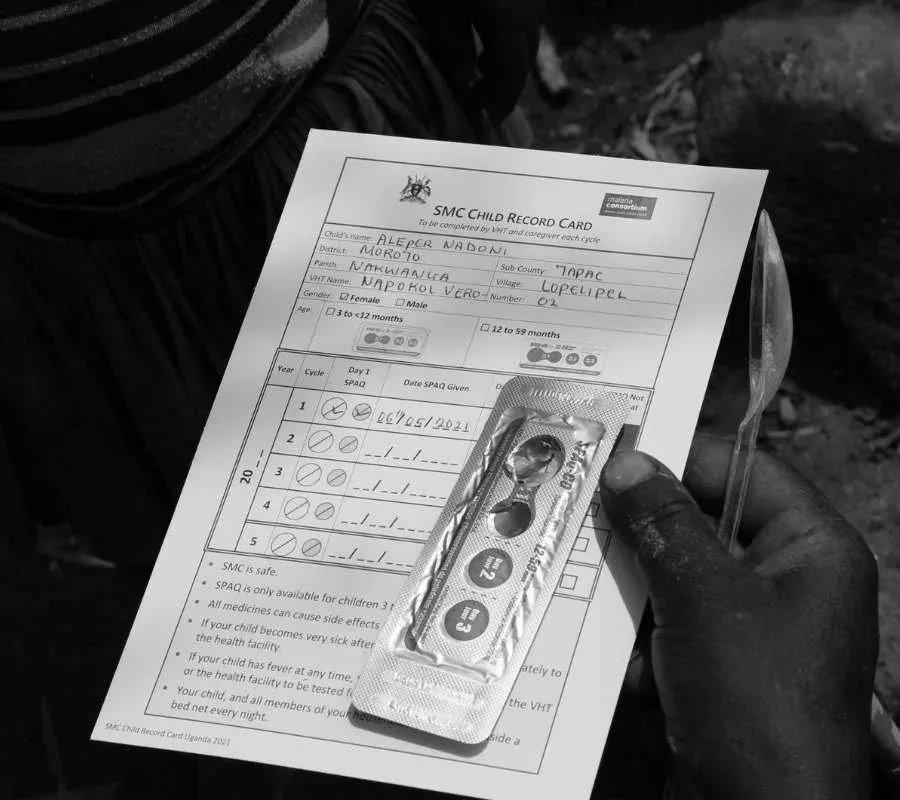
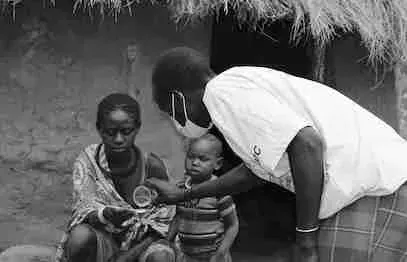
The Malaria Consortium supports the training of staff who administer the necessary medications to children in their homes. The children’s families are visited four times during the malaria season—once every month. During these visits, staff members are instructed to administer the first dose of medication themselves and to give two additional doses to the parents. The parents are then responsible for ensuring that the children take the medication over the following days.
According to GiveWell, depending on the region, it costs the Malaria Consortium between 5 and 6 USD to protect a child for the entire four-month prevention period recommended by the WHO—and between 2,000 and 7,000 USD to prevent a death from malaria.[6]

The impact
Several randomized controlled trials show that malaria chemoprophylaxis effectively reduces the incidence of malaria. According to a renowned “Cochrane review,” which conducted an aggregated analysis of various studies, chemoprophylaxis programs prevented approximately 75% of all clinical malaria cases. In cases where malaria does occur, chemoprophylaxis results in a less severe course of the disease—for example, the risk of anemia, a common complication of malaria, appears to be lower.[7][8]
The economic benefits of a decline in malaria infections are also immense: Every euro spent on antimalarial efforts in African countries increases that country’s gross domestic product by $6.75—an extraordinarily high figure.[9]
The organization
The Malaria Consortium was founded in 2003 and works to curb the spread of malaria and other diseases in Africa and Asia. The Malaria Consortium is currently active in twelve countries in Africa and Asia. The organization’s SMC program has been in place since 2013 and is primarily implemented in the Sahel region of Africa.
In 2024 alone, the Malaria Consortium was able to provide 25 million children with SMC medications. The organization conducts its own research and works closely with governments to provide operational and technical support to their respective health care systems.
GiveWell has listed the Malaria Consortium as a “top aid organization” since 2017. The effectiveness of SMC programs has been demonstrated in numerous independent studies. The organization itself is characterized by a high degree of transparency and cost-effectiveness. It also has room for growth. GiveWell has been providing regular grants in the millions to the Malaria Consortium since 2020.
Blog articles
- Poverty
Our donation fund: Fighting poverty in H2/2023
Our donation fund supports the Malaria Consortium for seasonal malaria chemoprevention (SMC) in Mozambique.

FAQs
Why are the preventive measures not carried out all year round?
Malaria cases do occur outside the high season, but year-round use of antimalarials is not recommended for several reasons. First, there is a risk that continuous use over several years by young children could have unstudied side effects. Outside the high season, protection by mosquito nets seems more appropriate. (Additional protection with bed nets is of course advisable during the high season as well). On the other hand, year-round use increases the risk of mosquitoes becoming resistant to antimalarial drugs over time.[10]
What are the side effects of the medication?
According to the WHO, the antimalarial drugs used for chemoprophylaxis are safe for infants and young children at the recommended dosage. Side effects are extremely rare: In Senegal, where nearly 800,000 treatments with sulfadoxine-pyrimethamine and amodiaquine were administered as part of seasonal malaria chemoprevention programs, no significant side effects attributable to these drugs were observed, even under intensive monitoring.[11] In the Cochrane evaluation with 9,533 participants, not a single side effect was reported.[7] The Malaria Consortium itself had reported in the past, as part of its monitoring activities, that nausea and vomiting had occurred in some cases after taking the medication. This was attributed to the tablets being bitter and difficult to swallow. Since water-soluble, orange-flavored tablets have been used, these side effects have practically disappeared. In addition, very rare cases of diarrhea, itching, headaches, mild abdominal pain, and rashes have been observed.
How are the costs of just under $6 per four-month treatment calculated?
The figure of $5.98 per four-month course of treatment per child is based on the weighted average cost of all treatments supported by Malaria Consortium from 2018 to 2021. This figure already takes into account the fact that not all children took the medication every month. The costs include the cost of medications, healthcare personnel, and all administrative and management costs for both the Malaria Consortium and the governments participating in the programs, although the latter costs are not covered by the Malaria Consortium. The detailed calculations can be found here .
Could my donation be used for other Malaria Consortium programs?
Based on the findings of the renowned GiveWell research institute, we recommend donating explicitly to the Malaria Consortium's Seasonal Malaria Chemoprevention Program, as its effectiveness has been proven by independent scientific studies and has demonstrated outstanding cost-effectiveness. Therefore, we earmark all donations, i.e. they are used exclusively for the SMC program.
Sources
[1] ↑ World malaria report 2025. World Health Organization (WHO). https://www.who.int/teams/global-malaria-programme/reports/world-malaria-report-2025 December 2025.
[2] ↑ World malaria report 2025. World Health Organization (WHO). https://www.who.int/teams/global-malaria-programme/reports/world-malaria-report-2025 December 2025.
[3] ↑ The World Health Organization states in its World Malaria Report 2025 610,000 deaths in 2024. Based on a slightly different methodology, the Institute for Health Metrics and Evaluation (IHME) estimates in its “Global Burden of Disease” (GBD) study, that in 2023, approximately 670,000 people worldwide died of malaria. About the GBD data: https://vizhub.healthdata.org/gbd-results?params=gbd-api-2023-permalink/240af42544bb8e05e2eac715b8ea2d7d (free registration required). Last accessed in December 2025.
More on this: Max Roser and Hannah Ritchie. Malaria. Our World in Data. https://ourworldindata.org/malaria. Last updated in February 2024.
[4] ↑ According to estimates by the “Global Burden of Disease” (GBD) study According to the Institute for Health Metrics and Evaluation (IHME), 408,616 children under the age of 5 died of malaria in 2023—that is, 1,119 children per day. 9% of the global deaths in this age group are attributable to malaria; in sub-Saharan Africa, the figure is 15%. Regarding the GBD data: https://vizhub.healthdata.org/gbd-results?params=gbd-api-2023-permalink/240af42544bb8e05e2eac715b8ea2d7d (Last accessed in December 2025.)
[5] ↑ Consolidated Guidelines for Malaria – Seasonal Malaria Chemoprevention (SMC). World Health Organization. https://app.magicapp.org/#/guideline/LwRMXj/section/EPMOYj. August 2025.
[6] ↑ Seasonal Malaria Chemoprevention. GiveWell. https://www.givewell.org/international/technical/programs/seasonal-malaria-chemoprevention Last updated in April 2024.
[7] ↑ Meremikwu MM, Donegan S, Sinclair D, Esu E, Oringanje C. Intermittent preventive treatment for malaria in children living in areas with seasonal transmission. Cochrane database of systematic reviews. https://www.ncbi.nlm.nih.gov/pubmed/22336792. February 2012.
[8] ↑ Lauren M Cohee et al. Preventive malaria treatment among school-aged children in sub-Saharan Africa: a systematic review and meta-analyses. The Lancet Global Health, Vol. 8. https://doi.org/10.1016/S2214-109X(20)30325-9. December 2020.
[9] ↑ William Jobin. Suppression of malaria transmission and increases in economic productivity in African countries from 2007 to 2011. MalariaWorld Journal, Vol 5, No. 4. https://www.malariaworld.org/malariaworld-journal/research-suppression-malaria-transmission-and-increases-economic-productivity-african. March 2014.
[10] ↑ Malaria Consortium. GiveWell. https://www.givewell.org/charities/malaria-consortium Last updated in April 2024.
[11] ↑ J. L. NDiaye et al. Safety of Seasonal Malaria Chemoprevention (SMC) with Sulfadoxine-Pyrimethamine plus Amodiaquine when Delivered to Children under 10 Years of Age by District Health Services in Senegal: Results from a Stepped-Wedge Cluster Randomized Trial. PLoS One. https://www.ncbi.nlm.nih.gov/pmc/articles/PMC5072628/. 2016.
External evaluation
The Malaria Consortium in the media
- How close are we to defeating malaria?. Financial Times. 2018.
- Drugs work 'like magic' against malaria in Africa's Sahel, experts say. Reuters. 2016.
- Malaria scheme cuts child deaths during Sahel's rainy season. The Guardian. 2016.
- Malaria: can we eradicate one of the world's deadliest diseases? The Guardian. 2015.