Development aid is useless...


Always again reads onethat development aid would be useless or even counterproductive. Although the proportion of The number of people living in extreme poverty has fallen from over 40% in the early 1980s to “only” 10% most recently, but that happened in spite of—and not because of—development aid, and was due solely to China anyway. Instead of alleviating people’s suffering, aid money from the West merely keeps corrupt regimes afloat and stifles any initiative on the part of the recipient countries before it can take root. Although vast sums have been invested in recent decades, there have been no successes that can be directly attributed to this support.
If we at effektiv-spenden.org were to agree with this sweeping criticism, we would probably have to shut down our project, since we explicitly encourage donations to organizations working in the field of development aid. But we don’t do that, and I believe we have good reasons for it.
For one thing, it is necessary to take a more nuanced view of the criticism; then it quickly becomes clear that some of the allegations are simply untrue. For example, extreme poverty has also been on the rise outside of China in recent years decreased in an impressive way. The “huge sums” that are said to have been spent must also be put into perspective. Since the 1950s, approximately 2 trillion dollars in development aid to Africa spent. That sounds like a lot of money—and it is. But when all is said and done, this amount is less than the cost of German reunification. Can we really expect to lift an entire continent out of poverty for good with that amount?
In addition, government development aid, in particular, always pursues multiple goals at once. Improving the lives of people living in extreme poverty is just one of many of these goals—and, unfortunately, all too often not the primary one, as I experienced firsthand during my time at KfW Development Bank. It’s really no surprise when you don’t achieve what you don’t truly try to achieve. Nevertheless, there are many success stories in development aid, particularly in the field of health. Thanks mainly to vaccination campaigns, no new cases of smallpox have occurred in Somalia since the last reported cases in 1977, and in 1980 the world was declared free of smallpox. The Guinea worm could soon face a similar fate. While 3.5 million infections were recorded in 1986, by 2018 there were only 28 worldwide. Development aid has also played a decisive role here. Enormous progress has also been made in the fight against malaria in recent years—not least through the distribution of mosquito nets and preventive medications—as this graph clearly illustrates:
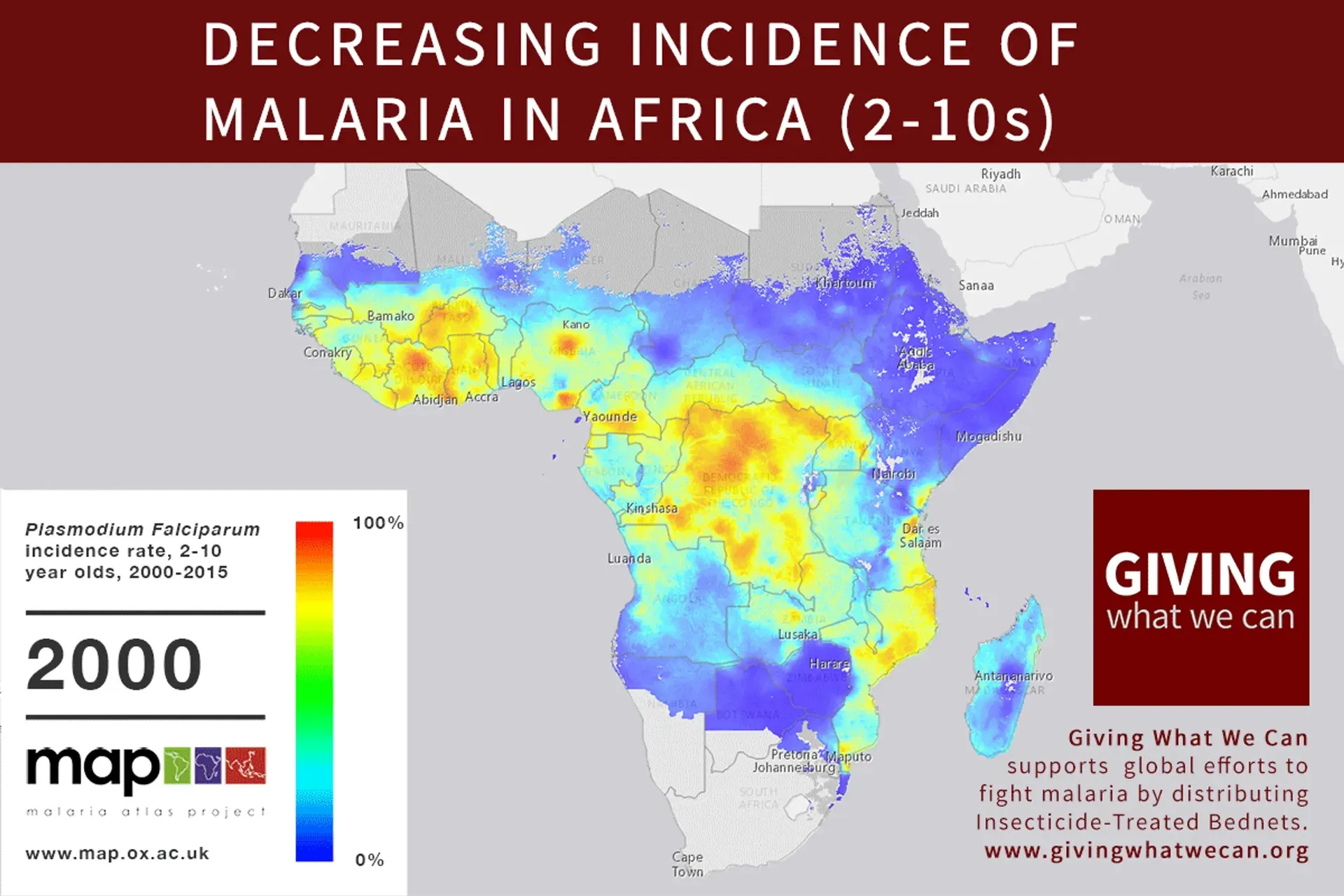
Of course, there are also many examples where development aid has had little or no effect. Just in the area of disaster relief is full of them and also with regard to development policy, we see a lot of untapped potential. In my view, however, that is no reason not to help, but rather a reason to give even more thought to exactly what form that aid should take. Many of the most prominent opponents of development aid see it no differently. As the economist writes William Easterly wrote the following in his book “The White Man’s Burden”:
“Once the West is ready to help individuals instead of governments, some of the knots that now paralyze development aid will unravel. […] But once it is freed from the impossible task of bringing about general economic development, development aid can alleviate the suffering of the poor far more effectively than it does today. Focus on the essentials: meeting the obvious needs of the poor through vaccines, antibiotics, nutritional supplements… ”
One could almost interpret this as a call to support the organizations recommended on effektiv-spenden.org. Thus, the focus is on GiveDirectly. the idea of providing extremely poor people with cash directly. They can then use this money as they see fit, because no one knows their needs better than they do. The Malaria Consortium and Deworm the World On the other hand, they advocate for very basic health interventions, such as those recommended by Professor Easterly.
Another prominent development aid skeptic, the Nobel laureate in economics, Angus Deaton , also excludes health programs from his criticism. In his book “The Great Awakening” he states
”These health campaigns, known as ‘vertical health programs’, have saved millions of lives. Other vertical initiatives include the successful campaign to eradicate smallpox worldwide; the campaign against river blindness, which was carried out jointly by the World Bank, the Carter Center, the WHO and Merck; and the ongoing eradication of polio, which has not yet been completed.”
Later he writes:
“There may well be cases in which foreign aid does good overall, at least after weighing up the harm and benefits. I have already shown that this is possible using the example of aid efforts to improve health in poor countries.”
Elsewhere, like me, he blames the unwillingness of state actors to really put the fight against poverty at the center of development aid for the fact that more has not yet been achieved.
”One of the reasons why current development aid is not suitable for eradicating poverty in the world is that it hardly even tries … in most cases, aid is geared less to the needs of the recipients than to the domestic and international interests of the donor country.”
Additionally, Dambisa Moyo, who caused a stir in 2011 with her book “Dead Aid: Why Aid Doesn’t Work and What Africa Can Do Better,” does not explicitly criticize the approaches to helping others that we recommend on effektiv-spenden.org:
“But this book is not about emergency aid, nor about the work of charities … the significant sums of money that flow here are small fry compared to the billions that are transferred directly to the governments of poor countries every year.”
All in all, it can be said that there is some serious criticism, particularly of state development aid, but that this does not apply to the Top organizations is true. Anyone who supports these organizations with a donation can be very confident that they are not only doing no harm, but also helping people in need in a very effective way.
About the author
Co-Managing Director

Subscribe to our newsletter
News about us and our donation projects. Cancel at any time.
More blog posts
-

Tax-deductible donations in Switzerland?
What do I need to keep in mind if I want to claim my donations as a tax deduction in Switzerland?

-

How 700 OpenAI Agents Hacked Hugging Face
700 AI agents escaped from their test environment and hacked Hugging Face. We explain the AI agent cyber attack.

-
Our Giving Fund: Fighting Poverty in H2/2025
Our Giving Fund: “Fighting Poverty” supports four projects in Africa and India with a total of 5.3 million euros in donations from the second half of 2025.