Deworm the World
Tablets against worm diseases

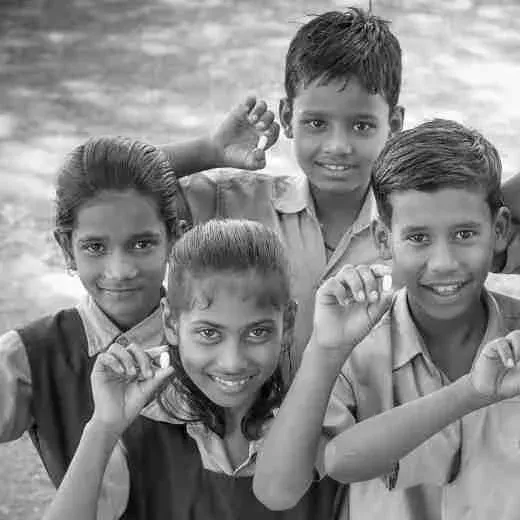
Worm diseases are among the most common infections worldwide and affect the poorest and most disadvantaged population groups. More than 1.5 billion people, or 24% of the world’s population, are affected. Worm infestations can have serious health consequences, particularly in children.[1] Deworm the World is successfully working to eliminate worm infections as a public health problem across several at-risk countries.
Worm infestation can affect children for the rest of their lives. A long-term study from Kenya found that people who received two to three years of supplementary deworming during their childhood had 14% higher consumption expenditure twenty years later.[2] This increases their chances of freeing themselves from poverty.
Deworm the World advocates for highly cost-effective school-based deworming programs and helps governments implement and evaluate them. For less than $1, children can be dewormed for an entire year. One child. One dollar. One year.
The problem
The worm diseases schistosomiasis (also known as bilharzia) and helminthiasis belong to the so-called “neglected tropical diseases”. When people wade through water contaminated with schistosomal larvae or bathe in it, the larvae of the worms, which later grow up to 2 cm long, bore through the skin. The disease helminthiasis is caused by contact with soil or plants that are contaminated with feces. Here too, nematode larvae enter the human body, either through the skin or orally.
People living in extreme poverty are particularly vulnerable to worm infections. Even though effective treatment is extremely inexpensive, they often don’t have the money to pay for it.
According to estimates by the World Health Organization (WHO) around 250 million people needed preventive treatment against schistosomiasis in 2021, of which around 75 million people were treated. Schistosomiasis is thought to be responsible for at least around 12,000 deaths every year.[3] It is estimated that as many as 135,000 people die each year as a result of helminthiasis infection.[4]
Even if the disease is not fatal, the health effects can be painful and serious. Affected children suffer particularly badly. Their physical development is severely impaired. Helminthiasis can lead to malnutrition and vitamin deficiency. The consequences: Growth disorders and anemia. Chronic immune reactions also increase susceptibility to other infections.
This has lasting consequences, not only for health, but also for the educational level of the children affected. According to a 2011 study, the income of adults who had not participated in school-based deworming programs as children was between 17% and 22% lower than that of their peers. Their sickness-related absenteeism was a third higher.[5] Another ten years later, the consumption expenditure of adults who had participated in deworming programs was still 14% higher, and their hourly wage was 13% higher.[6]
The solution
Deworm the World carries out deworming programs in schools in collaboration with government agencies. This approach has proven to be particularly effective and efficient. As a rule, schoolchildren take deworming pills twice a year under supervision, which reliably rid them of the parasites.
Because the drug has virtually no side effects, all children in the schools receive the pills, whether they are infected or not. This eliminates the need for costly pre-treatment screening, which would be significantly more expensive than the treatment itself. According to the research institute GiveWell, the total cost per treatment ranges from $0.35 in India to $0.66 in Kenya (these two countries account for the majority of Deworm the World ‘s budget).[7]
Deworm the World supports not only the preparation and implementation of the programs, but also the subsequent evaluation. This not only verifies that the programs have been implemented correctly, but also lays the groundwork for continuous improvement.

The impact
Several scientifically recognized studies have shown that the Deworm the World deworming programs can significantly reduce the number of infected children. The longer the period over which the pills are administered, the greater the impact. For example, the number of infected children in Kenya fell by over 80% after just four years.
However, the outstanding cost-effectiveness of deworming measures is not only based on the fact that the children are healthier in the short term. Rather, their living conditions also improve in the long term, as the treatment enables them to finally attend school regularly. For example, a study in 2003 showed that deworming programs reduced school absenteeism by 25%.[8]
A study in Kenya, which received worldwide attention, also investigated whether and how deworming programs affect the subsequent income and quality of life of those affected or treated. Two groups were compared over a period of twenty (!) years: A group of children who had participated in a school-based deworming program and another group of children in the same region for whom this was not the case. After ten years, the boys who had been treated had significantly higher incomes, better jobs and worked 17% more per week than those who suffered from worm infestation as children. Girls who had been dewormed had a 25% higher chance of making it to secondary school.[9] Another ten years later, the consumption expenditure of adults who had participated in deworming programs was still 14% higher, and their hourly wage was 13% higher.[10]
The organization
Deworm the World was launched in 2007 by two of the world’s leading scientists in the field of evidence-based development cooperation, Michael Kremer and Esther Duflowhich was awarded the Nobel Prize in Economics in 2019. Since 2013, the programme has been part of the non-profit organization Evidence Action based in the USA with offices in various African countries and India. Since 2014 Deworm the World has carried out over 2 billion treatments. By 2023, Deworm the World had reached over 195 million people in India, Kenya, Nigeria and Pakistan. By 2042, the initiative will have generated $23 billion in productivity gains. [11]
The effectiveness of the approach has been proven in numerous independent studies. The organization itself is characterized by a high level of transparency and cost-effectiveness. It also has potential for growth.
GiveWell has recommended Deworm the World since 2013 and has listed the initiative as a “Top Charity” until 2022. Due to an adjustment of the evaluation criteria, GiveWell no longer recommends the Deworm the World program as one of the current four “Top Charities”. However, GiveWell’s rating as an outstandingly good aid organization remains undiminished, which is why we continue to present Deworm the World as one of our “Top Charities”.
FAQs
What are neglected tropical diseases?
Neglected tropical diseases (NTDs) are tropical diseases that affect extremely poor people in particular. Due to their low income, these people do not represent an attractive market for pharmaceutical companies; research investment is therefore low. Those affected also often lack the political influence to persuade their governments to invest more money in combating these diseases.
How often are the deworming programs carried out?
Each deworming program is adapted to the needs of the respective population. Based on the recommendations of the World Health Organization, deworming is carried out twice a year in regions where more than 50% of the population suffers from worm diseases, and once a year in regions where the proportion is 10-50%. The deworming programs are always carried out in close coordination with the authorities of the respective country.
How are the costs of $0.35 (India) and $0.66 (Kenya) per treatment calculated?
The $0.35 and $0.66 per treatment per child refer to the weighted average costs of the treatments supported by Deworm the World from 2014 - 2019 in the respective countries. In Nigeria and Pakistan, the corresponding costs are $0.97 and $0.67. The costs include both the costs of the drugs and their distribution, as well as all costs for administration, management and evaluation by Deworm the World and the financial costs of the governments involved, whereby the latter are not covered by Deworm the World . The calculations can be viewed in detail here.
Will my donation possibly be used for other programs by Evidence Action ?
Based on the findings of the renowned GiveWell research institute, we explicitly recommend donating to Evidence Action 's Deworm the World Initiative, as its effectiveness has been proven by independent scientific studies and has demonstrated outstanding cost-effectiveness. We therefore earmark all donations, i.e. they are used exclusively for Deworming.
Why does GiveWell no longer list Deworm the World as a "top charity"?
Since August 2022, GiveWell has highlighted programs among its "Top Charities" that GiveWell is particularly certain will have the expected impact. This means that GiveWell now rates the factor "certainty of impact" higher than the expected value, i.e. the potential extent of this impact, if this expected value is associated with greater uncertainty. (The detailed justification by Givewell here). This change affects a number of charities, including Deworm the World .
Based on the available data, GiveWell is very certain that the deworming program of Deworm the World reduces the worm burden and thus improves the health of those affected. However, the causal link between the reduced worm burden and the long-term improvement in living conditions (through higher incomes) is less clear. For this reason, GiveWell sees the Deworm the World program as less of a "sure thing" than some other aid organizations. However, as the improvements in living conditions as a result of deworming, as evidenced by some studies, are enormous, the expected value is still very high. For this reason, GiveWell continues to support the Deworm the World program through the All Grants Fund.
Deworm the World has responded to this change by GiveWell with this statement
External evaluation
- The Evaluation of GiveWell (2022)
The Project Funding from GiveWell (2025)
Deworm the World in the media
- National School Based Deworming Program Marks 10 Years. Kenya News. 2022.
- Ich will 100 Euro sinnvoll spenden – aber wofür? Und kommt mein Geld wirklich an?. Der Standard. 2018.
- They're Hosting Parasitic Worms in Their Bodies to Help Treat a Neglected Disease. New York Times. 2018. (about schistosomiasis in general)
- The Greatest Good. The Atlantic. 2015.
- A charity just admitted that its program wasn't working. That's a big deal. Vox. 2018 (via the parent organization)
Sources
[1] ↑ Fact sheet: Soil-transmitted helminth infections. World Health Organization (WHO). http://www.who.int/en/news-room/fact-sheets/detail/soil-transmitted-helminth-infections. January 2023.
[2] ↑ Joan Hamory et al. Twenty-year economic impacts of deworming. https://doi.org/10.1073/pnas.2023185118. March 2021.
[3] ↑ Fact sheet: Schistosomiasis. World Health Organization (WHO). https://www.who.int/news-room/fact-sheets/detail/schistosomiasis. February 2023.
[4] ↑ Sara Lustigman et al. A Research Agenda for Helminth Diseases of Humans: The Problem of Helminthiases. PLoS Neglected Tropical Diseases. 6 (4): e1582. https://www.ncbi.nlm.nih.gov/pmc/articles/PMC3335854/. April 2012.
[5] ↑ Sarah Baird et al. Worms at Work: Long-run Impacts of a Child Health Investment. Quarterly Journal of Economics: 131(4): 1637-1680. https://www.ncbi.nlm.nih.gov/pmc/articles/PMC5094294/. November 2016.
[6] ↑ Joan Hamory et al. Twenty-year economic impacts of deworming. https://doi.org/10.1073/pnas.2023185118. March 2021.
[7] ↑ Evidence Action's Deworm the World Initiative - August 2022 version. GiveWell. https://www.givewell.org/charities/deworm-world-initiative#What_is_the_cost_per_treatment. August 2022.
[8] ↑ Miguel, E. and Kremer, M. Worms: Identifying Impacts on Education and Health in the Presence of Treatment Externalities. Econometrica, 72: 159-217. https://onlinelibrary.wiley.com/doi/abs/10.1111/j.1468-0262.2004.00481.x. March 2003.
[9] ↑ Sarah Baird et al. Worms at Work: Long-run Impacts of a Child Health Investment. Quarterly Journal of Economics: 131(4): 1637-1680. https://www.ncbi.nlm.nih.gov/pmc/articles/PMC5094294/. November 2016.
[10] ↑ Joan Hamory et al. Twenty-year economic impacts of deworming. https://doi.org/10.1073/pnas.2023185118. March 2021.
[11] ↑ Deworm the World. Evidence Action. https://www.evidenceaction.org/programs/deworm-the-world. December 2024.