How important is the 1.5°C mark?


Almost daily, we receive news of extreme weather events that are becoming more frequent or severe due to climate change. One negative record follows another.
What will it take to stop climate change and global warming? What does the 1.5 degree threshold mean? What role do donations play? And how effective can and should they be?
These are the topics of my current blog posts. In this first part, I try to put the 1.5 degree Celsius mark into perspective. In the second part, I will look at what it will take to limit global warming. And in the third part, I will explain how donations can make the most effective contribution.
The role of the 1.5°C threshold
The year 2023 was the warmest year on record with global temperatures approaching the 1.5°C mark. January 2024 already broke the next temperature record - according to Copernicus, the European Union’s Earth Observation Program, the 12-month average temperature was more than 1.5°C above the pre-industrial average of 1850-1900 for the first time.
Have we crossed the 1.5 degree threshold already? What role does this threshold play at all? And what does it mean if we cross it?
Why 1.5°C?
Global warming of no more than 1.5°C is now widely regarded as just about acceptable for the living conditions of the vast majority of people on Earth. However, the 1.5°C mark is relatively new - and already considered almost unattainable due to developments in the last 5-10 years.
The starting point was the UN Climate Change Conference COP21 in Paris in December 2015, when 197 countries agreed to a new international treaty on climate change with the goal of limiting global warming to “below 2°C above pre-industrial levels and pursuing efforts to limit the temperature increase to 1.5°C above pre-industrial levels, recognizing that this would significantly reduce the risks and impacts of climate change.”
Since then, the more ambitious of the two targets, the 1.5°C threshold, has come to the fore. The Alliance of Small Island States (AOSIS), in particular, considered 2°C an unacceptable level of warming and an existential threat, and was joined by other Least Developed Countries (LDCs) and civil society to push for the more stringent 1.5°C mark.
In the scientific context, the threshold has been taken up in the IPCC Special Report “Global Warming of 1.5°C” (SR1.5). SR1.5 states that a temperature increase of 2°C would result in significantly higher climate risks and impacts than a temperature increase of “only” 1.5°C.
This also makes it clear that the threshold, while scientifically based, is also politically motivated and can ultimately be described by an interdependence of science and politics .
Haven’t we already crossed the 1.5°C mark?
Even though we are getting closer and closer to the 1.5°C threshold: There is a difference between the global temperature on a single day, or even over an entire year, and the long-term average. When we talk about the 1.5°C threshold in negotiations such as the UN Climate Change Conference COP28, we mean the latter - 1.5°C warming means an average over a decade. According to the IPCC’s Synthesis Report for the Sixth Assessment Report (AR6), the global surface temperature in the period 2011-2020 was already 1.1°C above pre-industrial levels. Therefore, if global greenhouse gas emissions remain high, we can expect to cross 1.5°C in about ten years, based on a 10-year average. The only way to prevent this is for global greenhouse gas emissions to peak by 2025 and then decline very rapidly. More on this in part two.
What happens if we cross the 1.5°C threshold?
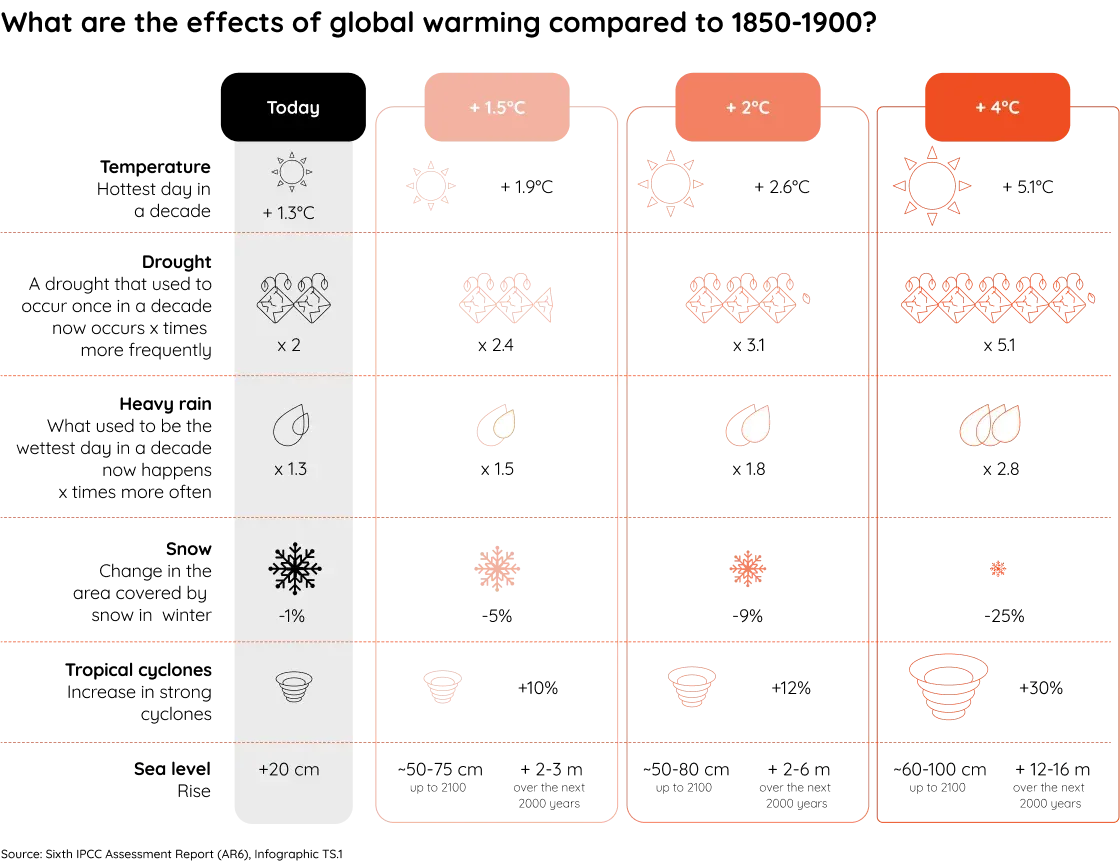
Climate change is already “affecting every inhabited region across the globe, with human influence contributing to many observed changes in weather and climate extremes” (cf. IPCC, p. 10), as we now regularly learn from the news. Accordingly, even a transient warming of only 1.5°C, as observed in 2023, has significant impacts.
With every further increase in global warming, the intensity and frequency of extreme events such as heatwaves, heavy rainfall or droughts also increase, and with them the damage caused by global warming. Unfortunately, the correlation is not linear. Each additional tenth of a degree Celsius of warming causes even greater climate damage than the previous tenth of warming, and the higher the temperature, the greater the additional risks and damage that further warming entails.
There is also the risk of so-called tipping points in the Earth system. In everyday language, a tipping point is the point at which a small further change in a system makes a big difference - for example, the point at which you actually tip over on a wobbly chair. In the context of the climate crisis, a tipping point is the point at which a system inexorably - and without the need for further temperature increases - “tips” into a new state. For example, the Greenland ice sheet is at risk of reaching a point at which the melting of the entire ice sheet can no longer be stopped, regardless of what happens to greenhouse gas emissions from that point on.
The co-director of the Potsdam Institute for Climate Impact Research (PIK), Johan Rockström, describes in a recent interview with the German newspaper Die ZEIT that five tipping points for important climate-regulating systems (e.g. certain forests, ocean currents and ice masses) will most likely be reached if the Earth warms by just 1.5°C. The likelihood of reaching these and other tipping points increases as temperatures continue to rise.
It is important that we do not see 1.5°C as a “cliff”, but as an ambitious threshold. A temperature increase of 1.51°C does not mean the immediate end of the world, just as warming of 1.49°C does not mean that climate change has no impact. Limiting global warming to 1.4°C is better than 1.5°C. 1.7°C is better than 1.8°C, 2.1°C is better than 2.2°C, and so on. So the more we can limit global warming, the less the consequences. And the more Earth has already heated up, the greater the consequences of further temperature increases. Every tenth of a degree counts.
To the next article of the series.
About the author
Founder & Former Head of Research

Subscribe to our newsletter
News about us and our donation projects. Cancel at any time.
More blog posts
-

Tax-deductible donations in Switzerland?
What do I need to keep in mind if I want to claim my donations as a tax deduction in Switzerland?

-

How 700 OpenAI Agents Hacked Hugging Face
700 AI agents escaped from their test environment and hacked Hugging Face. We explain the AI agent cyber attack.

-
Our Giving Fund: Fighting Poverty in H2/2025
Our Giving Fund: “Fighting Poverty” supports four projects in Africa and India with a total of 5.3 million euros in donations from the second half of 2025.