How do we stop climate change?

Almost daily, we receive news of extreme weather events that are becoming more frequent or severe due to climate change. One negative record follows another.
What will it take to stop climate change and global warming? What does the 1.5 degree threshold mean? What role do donations play? And how effective can and should they be?
These are the topics of my current blog posts. In the first part, I try to put the 1.5 degree Celsius mark in perspective. In this second part, I look at what is needed to limit global warming. And in the third part, I will explain how donations can make the most effective contribution.
How do we stop climate change?
Carbon in the atmosphere is “forever”. Once released, CO2 accumulates and stays in the atmosphere, influencing the climate for hundreds to thousands of years. This means that even if we reduce emissions to zero, global warming will stop, but the world will not cool down for centuries or even millennia. It also means that as long as we continue to emit CO2 (and other greenhouse gasses, GHG), global warming will continue.[1]
This leads to three important concepts for climate action: “net zero emissions”, i.e. the balance between the amount of GHGs that’s produced and the amount that’s removed from the atmosphere, “net negative”, i.e. a situation in which the amount of GHGs that’s removed exceeds GHG emissions, and so-called “carbon budgets”.
Only by achieving net-zero emissions (or GHG neutrality) can we - as a first step - prevent a further rise in global temperature. The rule of thumb for staying within the 1.5°C threshold is that we need to roughly halve global CO2 emissions by 2030 and get to “net zero” by 2050. “Net zero” means that the same amount of GHG emissions still produced by human activity is removed from the atmosphere so that the stock of GHGs in the atmosphere no longer increases. The remaining emissions must therefore be compensated by so-called “negative emissions”, i.e. by natural and technological carbon sinks. However, technological carbon removal is still in its infancy.
However, net zero emissions are not only necessary to limit global warming to 1.5°C. Any other limitation of global temperature increase (e.g., to 2°C or even 2.5°C) will ultimately also require achieving net zero emissions, only at a later point in time.
As a second step, the concept of “net negative” focuses on the time after net zero emissions have been achieved. The Federal Climate Change Act (KSG), for example, states that “After the year 2050, negative greenhouse gas emissions are to be achieved..” (KSG Section 3 (2))
While “net zero” describes a state in which remaining emissions are balanced by an equal amount of GHG removed from the atmosphere, “net negative” describes a state in which removals exceed emissions. Many scenarios for staying below the 1.5°C threshold in the long term require the world to become net negative in the second half of this century. In these scenarios, the failure to reduce emissions fast enough eventually leads to global warming temporarily exceeding the 1.5°C mark. To return to below 1.5°C later in the century, billions of tons of CO2 would have to be removed from the atmosphere.
The date by which we must achieve net-zero emissions is determined by carbon budgets. (Also called “CO2 budgets” or “emissions budgets”.)[2] These budgets indicate how much CO2 we can emit before we reach a certain level of global warming.
Due to the longevity of CO2 in the atmosphere, the temperature increase depends on both future and past GHG emissions. This means that global warming is caused by the long-term accumulation of GHGs in the atmosphere, which has been (and will continue to be) significantly increased by human activities.
The graph below illustrates this relationship: For example, in order not to exceed the 1.5°C threshold with a 50% probability, only 275 billion tons of CO2 (gigatons, Gt) can be emitted from 2024 onwards.[3] This in turn corresponds to about seven years of global emissions at current levels. (Assuming emissions fall to zero after year 7.) Budgets for higher temperature limits can also be derived in the same way, as shown in the graph.

Where can we start?
Three aspects are key to limiting global warming as much as possible:
- We need to drastically reduce emissions in all sectors - any exception will result in high additional costs for carbon removal.
- Every region and every country must do its part - that is the only way we can succeed together.
- Time is of the essence - fast action is crucial.
Which sectors are important?
Across all sectors shown in the graph below, emissions from fossil energy production and consumption based on coal, oil and gas account for about three quarters of global GHG emissions. Moving away from fossil fuels and toward renewable energy such as solar and wind, and the associated electrification of much of the transportation, industrial, and heating sectors, is therefore a top priority.
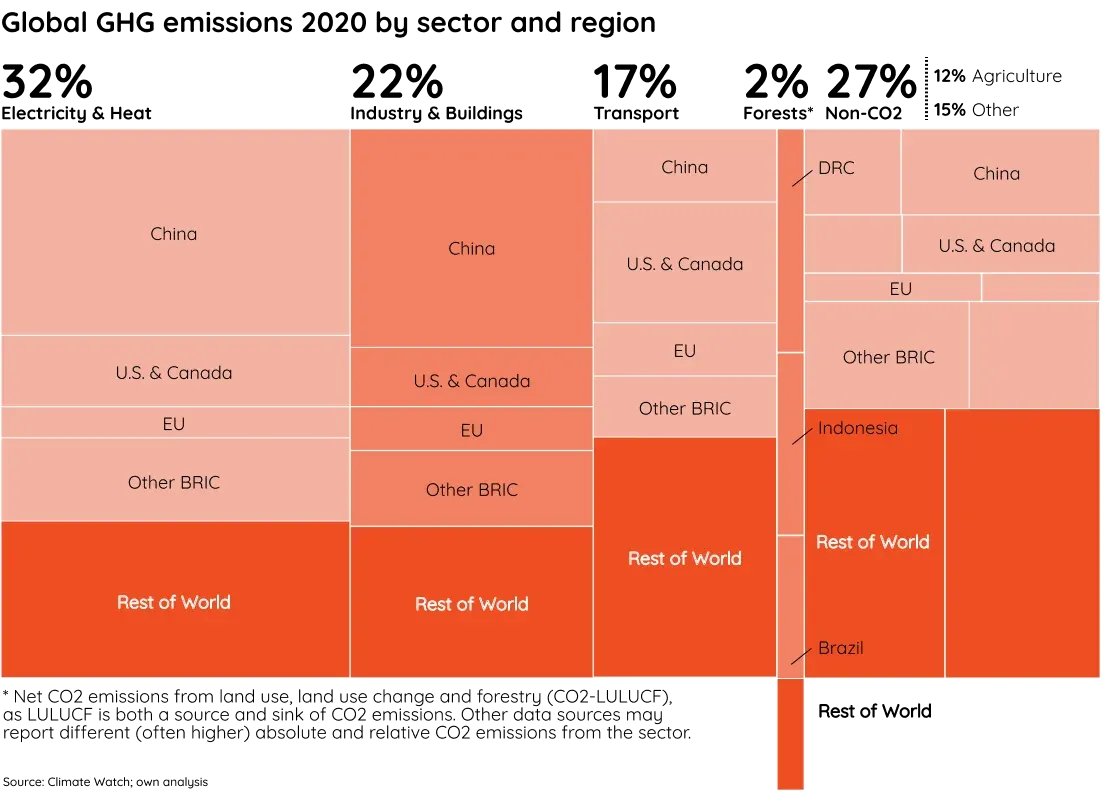
However, many other fields of action are also relevant, which are often far less in the focus of public reporting. These are, for example
- Apparent niches such as aviation which is both disproportionately harmful to our climate due to the effect of contrails and particularly difficult to decarbonize.
- Sectors with a high share of global emissions (such as the cement industry) and a traditionally low rate of innovation. This makes it particularly difficult to change regulations and standards and to develop innovative, climate-neutral solutions.
- Non-CO2 emissions, e.g., methane from agricultural livestock farming, the oil & gas industry, and waste management.
- High CO2 and N20 emissions from agriculture.
- Carbon Dioxide Removal (CDR) to compensate for unavoidable residual emissions.
What role do individual regions and countries play?
If we add a geographical perspective, two things become clear: first, the importance of individual sectors and issues often varies considerably from one region or country to another. And second, no country or region can solve the climate crisis on its own, everyone has to do their part. In the logic of net zero, there is little room for others to compensate for the inaction of some.
China is currently the world’s largest emitter, accounting for ~26% of global emissions, followed by the US with an 11% share. The EU accounts for 6% of global emissions. If we look at the cumulative historical CO2 emissions since 1850, which are responsible for the global warming already caused today, the share of Western industrialized countries increases. The share of the US is then ~22%, that of the EU 12%. Germany has a share of just under 4%. (China’s share is halved to 13%).
Only seven countries in the world currently account for more than 2% of global GHG emissions individually - but their total is still 59%. If we look at historical CO2 emissions, the figure rises to ten countries (including Germany) with a total share of 68%. This underscores the responsibility of the historical emitters, especially the Western industrialized countries.
On the other hand, the world will not be able to cope with climate change if countries with “negligible” emissions do nothing. This becomes clear when we look into the future, which is crucial for the remaining carbon budgets. While GHG emissions are already falling in regions such as the EU, they continue to rise in many emerging and developing countries. The combined share of the US and Europe in projected end-of-century emissions is less than 20% (see chart). When laws and regulations already in place to reduce emissions are taken into account, the US and Europe account for only 10% of affectable emissions.
Avoiding carbon lock-in - locking in high future emissions by building new fossil fuel infrastructure in emerging and developing countries - is therefore critical to achieving net zero emissions globally.

What role does time play?
As described above, we must achieve net zero emissions to stop climate change. The faster we get there, the more we can limit global warming. That is why the period to 2030 is often called the critical decade for climate action. The graph below from the Drawdown Roadmap shows why: By far the largest share of the GHG emissions reductions needed to achieve net zero must be achieved by 2030. A simple reason for this is that halving our current high level of CO2 emissions will require the largest reductions. (A further halving between 2030 and 2040 will require “only” a quarter of today’s emissions). Another is that emissions reductions made today can save more CO2 year after year than reductions made only a few years from now.
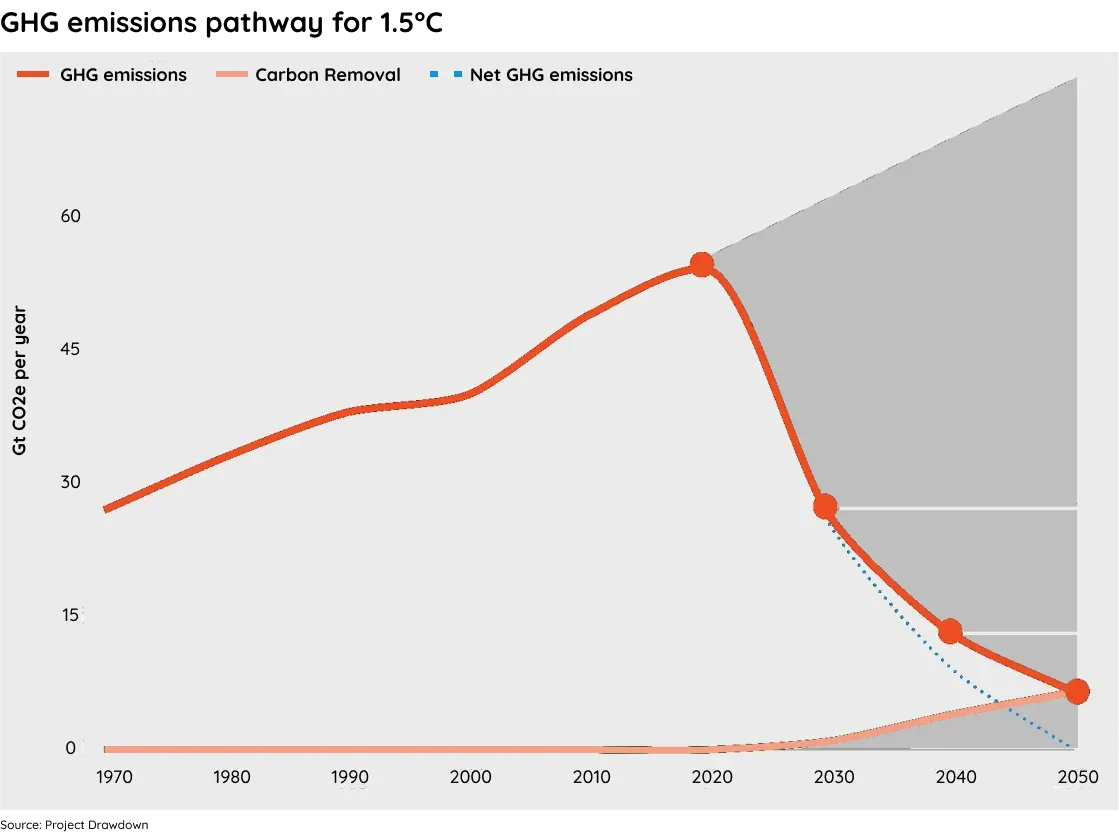
So not only do we need deep cuts in emissions across all sectors and countries, but a lot of those cuts have to come in the short term to keep temperature increases as low as possible.
However, by focusing on this decade and 2030, we often lose sight of the need to continue our efforts beyond 2030. In fact, achieving the necessary CO2 reductions may become more difficult because the low-hanging fruit, i.e. the (perceived) easy levers and measures, have already been implemented. Therefore, in addition to immediate and widespread implementation of already available mitigation measures, we need to start thinking today about further savings beyond 2030. In particular, we need to invest in research, development and pilot projects in areas where cost-effective solutions to reduce and avoid emissions are not yet available.
Aren’t we doing enough already?
Today, the climate crisis makes headlines almost daily. Global climate-related investments have reached an annual volume of over 1.3 trillion US dollars. That sounds like a lot, and it is about 1% of global GDP. However, in 2022, financial support for fossil fuels from the G20 countries alone stood at the same level, mainly in the form of subsidies for fossil fuel consumption.
Experts estimate that global investment would have to increase fivefold to avoid just the worst consequences of climate change. According to a new study by the Potsdam Institute for Climate Impact Research (PIK) in the science journal Nature, even these sums pale in comparison to the consequential costs of climate change. According to the study, the GHGs emitted to date alone will cause global annual damage of 38 trillion US dollars by the middle of the century,[4] which, according to the study, corresponds to a 19% percent drop in the world economy compared to a world without climate change.
It is clear that both governments and the market have failed to adequately address climate change. As a result, despite significant progress in recent years, an extraordinary effort will still be required in a very short period of time to effectively address the climate crisis.
Go to the next article or go back to the first article of the series.
About the author
Founder & Former Head of Research
Footnotes
[1] ↑ Global warming is caused by both CO2 and other greenhouse gasses such as methane. The effects of different GHGs on the climate are determined by two key characteristics: their longevity in the atmosphere and their ability to absorb energy. The other GHGs besides CO2 absorb much more energy, but are less long-lived. (Methane, for example, remains in the atmosphere for about 12 years, compared to centuries for CO2). The most common method of combining these factors and measuring climate impact is the "global warming potential" (GWP). The Intergovernmental Panel on Climate Change (IPCC) in its latest assessment report AR6 estimates the climate impact of methane from fossil sources to be 82.5 over 20 years (GWP20) and 29.8 over 100 years (GWP100). This makes it clear that methane, unlike CO2, contributes to global warming primarily in the short term. Due to the particular relevance and longevity of CO2 and to make this article easier to read, we will focus primarily on CO2.
[2] ↑ See footnote 1. Due to the particular relevance and longevity of CO2 and for readability, we focus on CO2 budgets. Due to remaining non-CO2 emissions, we will always achieve net-zero CO2 emissions before we achieve net-zero greenhouse gas emissions.
[3] ↑ The use of a 50% probability in such budgets has been criticized. In most real-life situations, at least if they involve risk to one's life or large economic consequences, one would rather use values of, say, 67%, 75%, 95%, or even higher. (Nobody would get on an airplane that had a 5% chance of crashing - that would be 5 crashes per 100 flights). Such an increase in probability significantly reduces the remaining CO2 budget.
[4] ↑ In international dollars (2005) in the year 2049.

Subscribe to our newsletter
News about us and our donation projects. Cancel at any time.
More blog posts
-

Tax-deductible donations in Switzerland?
What do I need to keep in mind if I want to claim my donations as a tax deduction in Switzerland?

-

How 700 OpenAI Agents Hacked Hugging Face
700 AI agents escaped from their test environment and hacked Hugging Face. We explain the AI agent cyber attack.

-

Our Giving Fund: Fighting Poverty in H2/2025
Our Giving Fund: “Fighting Poverty” supports four projects in Africa and India with a total of 5.3 million euros in donations from the second half of 2025.