Emergency aid after the earthquake in Turkey and Syria?

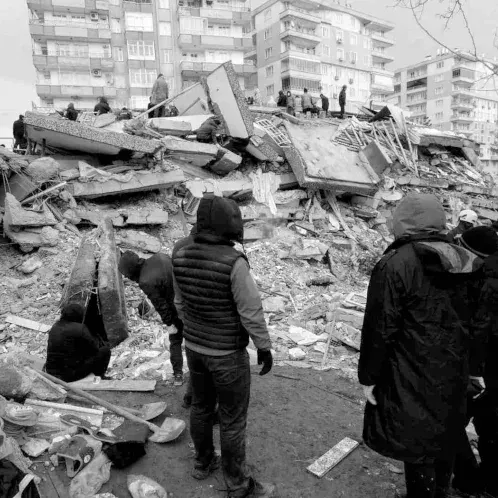
The news we are receiving from Syria and Turkey is terrible. The death toll is being revised upwards almost by the hour. At the time of writing, it is over 40,000. The images are even worse, such as the photos of aid workers pulling bleeding and distraught babies from the rubble. And perhaps worst of all is the image of people still lying under the rubble, screaming for help as their loved ones try to dig their way to them with their bare hands.
Many people in this country want to help and are looking for ways to donate to the relief effort. And then there is the care and shelter for the many thousands of injured people who have lost everything.
The images and news from the earthquake region are of human suffering unfiltered. The scale of what is happening there is unimaginable. We feel powerless and want to do something.
The challenges of disaster relief
Of course we feel the same way about giving effectively. And of course we’re being asked these days whether we shouldn’t donate to organisations that help people in need in this situation.
Experience shows that acute catastrophes accompanied by images trigger a need for help in many people. In Germany, but also in many other countries, this can lead to an enormous volume of donations. In the case of other catastrophes, which are neither particularly topical nor particularly powerful in terms of images, a lot of money then flows to organizations that are active in places that we have a concrete idea of thanks to the current news.
A very high level of donations triggered by an acute event can, however, lead to situations where individual organizations receive more money than they can effectively utilize. The devastating earthquake in Haiti in 2010 serves as an example. The overwhelming outpouring of aid and donations resulted in billions of relief funds needing to be accommodated in Haiti, even when there were scarcely meaningful uses left for the money. This can be explained by the legal obligation of organizations to use donations for the purpose defined by the donor—even when, by human judgment, there is no additional benefit to be gained.
The “silent” disasters
At the same time as events such as those currently taking place in Turkey and Syria, other “quieter” disasters are occurring in many places around the world. Unlike earthquakes, however, they do not occur suddenly, but are always there. As a result, they rarely appear in international news coverage. There is no current or urgent cause. And there is a lack of powerful images.
An example of silent disasters are the infants who die every day from preventable diseases. Each day, over 1,000 children die from malaria alone, a disease easily preventable through the provision of mosquito nets. That’s an earthquake every day. Because this suffering largely occurs unnoticed by the global public, donations in fields like this one remain low. Yet with just a few thousand euros, a child’s life can be saved and many more children spared pain and suffering. However, one can also view it differently: precisely because high child mortality, such as from malaria, is not the focus of public reporting and donations are low, individuals can achieve a lot with their donation here.
Admittedly, this is a very sober view in the face of news and images that emotionally stir us all and practically cry out for help. At Effective Altruism, however, we consider it our duty to ensure that, especially in moments like these, people who want to help are aware of all the options to do so effectively. How each individual decides to act is, of course, always up to them. If the decision is made to support emergency relief efforts, we also tip our hats to that – and we have a current recommendation: The organization we endorse, GiveDirectly, has launched a project that supports Syrian refugees in Turkey affected by the earthquake. If you’d like to support this project and need a donation receipt for it, please feel free to reach out to us.
(The text was updated on 14.02. with regard to the number of victims and another source. On 03.3. the reference to the GiveDirectly program was added).
About the author
Founder & Director of Donor Advisory

Subscribe to our newsletter
News about us and our donation projects. Cancel at any time.
More blog posts
-

Tax-deductible donations in Switzerland?
What do I need to keep in mind if I want to claim my donations as a tax deduction in Switzerland?

-

How 700 OpenAI Agents Hacked Hugging Face
700 AI agents escaped from their test environment and hacked Hugging Face. We explain the AI agent cyber attack.

-

Our Giving Fund: Fighting Poverty in H2/2025
Our Giving Fund: “Fighting Poverty” supports four projects in Africa and India with a total of 5.3 million euros in donations from the second half of 2025.