Deductibility of donations in Austria


Note dated June 18, 2025: The article below is out of date. Donations made through the Effektiv Spenden platform are now tax-deductible in Austria as well. The article will be completely revised shortly.
Donations via the platform Effektiv Spenden Unfortunately, in Austria - unlike in Germany and Switzerland - are currently not tax deductible. The same applies to direct donations to our recommended organizations.
In this article we explain, i) why that is, ii) whether there is a chance of deductibility of donations in the future and iii) why it is advisable to donate to the world’s most effective charities, even without tax benefits.
The most important thing first: If you want to do as much good as possible, it is better to donate less than to donate less effectively. We assume that our top recommendations are 10 to 100 times more effective than average initiatives. Given these large differences in cost-effectiveness, you can disregard the lack of donation deductibility.
How charitable donations work
Austria promotes monetary donations from individuals and businesses to certain charitable organizations: Donations to such tax-privileged non-profit organizations (NPOs) reduce the donor’s tax base for income tax, personal income tax, or corporate tax by up to 10% as special or business expenses.
This state donation incentive is reserved for organizations that are either legally considered tax-privileged (e.g., universities, public schools and kindergartens, or volunteer fire departments) or recognized as tax-privileged by the tax office based on certain criteria. The “List of Privileged Institutions (Donations, Church Contributions, etc.)” can be accessed on the website of the Federal Ministry of Finance (BMF). At the end of 2023, this list included 6,007 organizations, among them 4,518 volunteer fire departments.
Why Effektiv Spenden is not (yet) eligible for charitable donations
Neither Effektiv Spenden nor the charities we currently recommend are currently listed as tax-privileged on the BMF list.
The main reason for this is that none of the organizations are based in Austria. Effektiv Spenden is based in Berlin and Basel, our recommendations are often in the United States, the United Kingdom or elsewhere in the world.
The Austrian tax benefit for donations is theoretically open to “comparable foreign entities of a member state of the European Union or a state with which there is comprehensive administrative assistance” in addition to Austrian NPOs. However, in practice, national differences in non-profit law significantly hinder or even prevent their inclusion.
However, thanks to many improvements in the Non-Profit Reform Act 2023, there is now hope for a solution that will allow us to offer tax-deductible donations through our platform in Austria starting in 2025.
To this end, on August 13, 2024, with Effektiv Spenden Österreich (ESO) – Verein für wirkungsorientierte Philanthropie a new legal entity headquartered in Vienna founded, through which our work in Austria will be conducted in the future. There are still a few hurdles to overcome on the path to becoming a tax-exempt charity, but the establishment of this new organization is definitely an important milestone. We are constantly updating the article and, of course, will also provide updates in the Newsletter About updates.
Why effectiveness is more important than deductibility
When talking to people from Austria, we often experience uncertainty when it comes to the topic of tax deductibility of donations: Should you really forego the tax advantage? Or doesn’t it make more sense to make a compromise when choosing an aid organization, but take the tax savings with you?
It is clear: those who donate to tax-deductible organizations can donate more generously. After all, they get a portion of their donation back from the tax office. The amount of tax savings depends on the personal marginal tax rate, that is, how much tax is paid on the last euro earned in the year.
Let’s take an example: Julia has a gross annual salary of €55,000 and donates €2,500 to a tax-deductible organization. With her marginal tax rate of 40%, she saves €1,000 in income tax. (Tax savings = Donation amount × Marginal tax rate, see table.) After deducting the tax credit, only €1,500 of the €2,500 donation comes from her net income; the remaining €1,000 is covered by the state. Thus, through tax deductibility, Julia effectively increases her donation amount by 1.67 times to reach the total donation of €2,500.
If Julia’s income was over €1 million per year and she paid the top tax rate of 55%, her donation would be increased by a factor of 2.2; her own share of the €2,500 donated would then be €1,125.
Based on independent studies by leading experts, we at Effektiv Spenden believe that our recommendations are 10 to 100 times more effective than average initiatives. So, if Julia donates her share of €1,500 through our platform to one of our top recommendations and forgoes the tax deductibility, she also increases the impact of her donation by 10 to 100 times. The effect is significantly greater than the tax benefit.
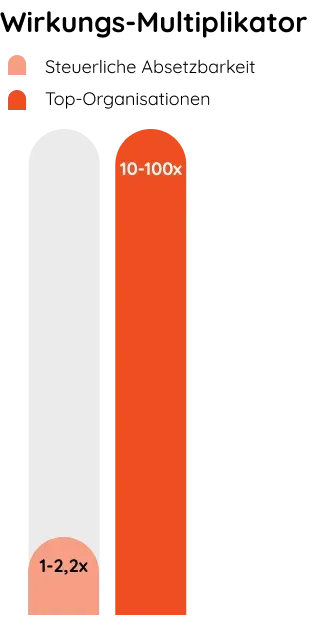
So, if you are not entirely sure whether the tax-favored project of your choice is truly cost-effective (and for most projects, this unfortunately remains unclear), forgo the tax benefit and instead donate to a project whose effectiveness is proven – that way, you will achieve more good!
(Image source: Austrian flag at the stern of the ship, Wolfgangsee in July 2019, taken by DominikCK1999 and published under CC BY 4.0 DEED)
About the author
Director of Donor Relations

Subscribe to our newsletter
News about us and our donation projects. Cancel at any time.
More blog posts
-

Tax-deductible donations in Switzerland?
What do I need to keep in mind if I want to claim my donations as a tax deduction in Switzerland?

-

How 700 OpenAI Agents Hacked Hugging Face
700 AI agents escaped from their test environment and hacked Hugging Face. We explain the AI agent cyber attack.

-

Our Giving Fund: Fighting Poverty in H2/2025
Our Giving Fund: “Fighting Poverty” supports four projects in Africa and India with a total of 5.3 million euros in donations from the second half of 2025.