How to effectively defend our democracy

Author’s Note: This post was written in 2024. At that time, the only priority was defending democracy in Germany the focus of our charitable giving. Since August 2025, we have been working with Power for Democracies a specialized research partner, which allows us to international recommend effective democracy projects. However, much of the text below goes beyond a purely German perspective; its points can be applied to other countries as well.
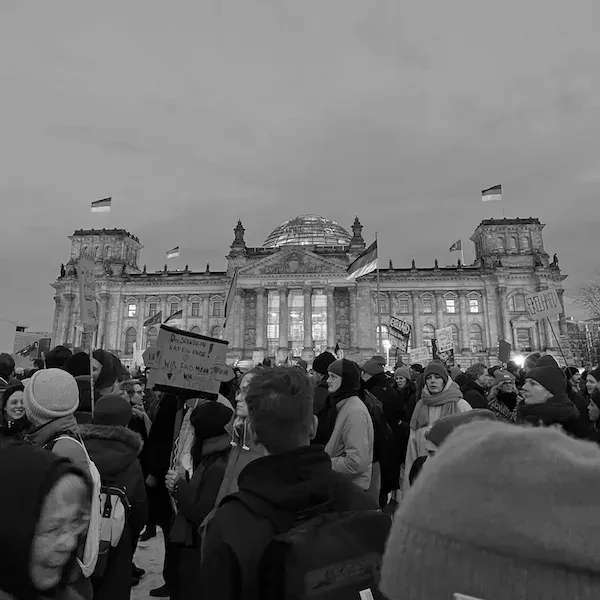
Since the publication of the CORRECTIV-investigation “Geheimplan gegen Deutschland” (Secret plan against Germany) on January 10, 2024, the threat to democracy has reached the consciousness of many Germans. More than 3 million people have taken to the streets in recent months to demonstrate against right-wing extremism, representing the largest public protest in Germany since the World War II.
On sober reflection, is the current excitement justified? And if so, what does this mean for donations, especially effective donations?
This is the subject of our two latest blog articles. In this first part, I shed light on what democracy actually is and what we know about measures to defend and strengthen it. In the second part , I share my thoughts on where donations can be put to good use in Germany today.
How can we effectively defend our democracy?
If you look at the interest in the search term “democracy” on Google Trends over the past 5 years, for example, you can see that this is not the first time that the threat to democracy has been in the spotlight. However, the concern is unusually intense and may last longer than before, because the problem has now - for all to see - arrived in Germany . Fascism 2.0 appears to be rapidly gaining popularity and influence. Unlike in the past, it is no longer “the others” such as the US or India, Hungary, Turkey and recently even the Netherlands, whose democracies are being attacked by mostly ethno-social-nationalist parties and populists with clearly illiberal and autocratic aims.
In addition, in the global super election year of 2024, Germany will also hold important elections : the European Parliament will be elected in June, and the state parliaments in Saxony, Brandenburg, and Thuringia will be elected in September. Current polls predict a huge shift to the right in Europe - with the AfD leading in all three states. A now conceivable scenario: A right-wing extremist like Björn Höcke, who despises humanity and democracy, could become prime minister.
So how justified is the current uproar?
What is democracy?
For many people, democracy is a largely vague and abstract concept. Perhaps it is like electricity, which just comes out of the socket without much thought or effort. The most common spontaneous definition of democracy is: “We go and vote.”
Yet the defense of democracy is the most complex issue that I personally and we at Effektiv Spenden have ever dealt with in recent years. Why is that?
The direct translation from ancient Greek is still easy: democracy means “Rule of the people”. However, a precise and globally recognized definition of modern democracy is difficult: constitutions and political practice show great differences in the composition and weighting of democratic principles, institutions and processes.
For potential donors, this leads directly to a considerable dilemma: if there is already no uniform map of democratic elements, it is naturally all the more difficult to identify, compare and evaluate measures to preserve democracy. More on this later.
The most ambitious project to define and empirically measure democracy can be found at the V-Dem (Varieties of Democracy) Institute of the University of Gothenburg, Sweden. Currently, with the help of around 3,700 experts worldwide, around 470 democracy indicators in five areas are collected, aggregated and weighted, and made comparable and interpretable over long periods of time. Furthermore, V-Dem annually provides excellent reports on the state and trends of forms of government around the world.
But other renowned institutions also make a major contribution with their publications in order to take a sober and objective look at the political world - e.g. Freedom House, the EIU Democracy Index or Polity.
And in order to make all this accessible to the general public - especially donors - a comprehensive democracy portal has been available on the well-known data platform Our World in Data since 2022: largely financed by people we have supported as part of our donation advice. The Democracy Data Explorer in particular now leaves little to be desired in terms of transparency.
What about democracy?
The results of all these studies have one thing in common: they have been sobering for years. From a global perspective, the worldwide spread and deepening of democracy came to a temporary halt around the year 2000 - and has accelerated since 2015. It was replaced by a mostly creeping, sometimes rapid relapse into illiberal or autocratic forms of government:
According to the data set “Regimes of the World” , in the year 2004 approx. 17% of the world’s population lived in a highly developed “liberal democracy”, as we have appreciated in Germany for many years; a further approx. 36% lived in a so-called “electoral democracy”, a form of democracy in which various structures, processes and rights that we take for granted only exist to a limited extent. Taken together, this means that 53% of the world’s population lived under largely democratic conditions.
By 2022, these shares of the world’s population were only 13% (“liberal”) and 16% (“electoral”), for a total of 29% - a huge decline. In just 16 years, more than a quarter of the world’s population has thus ended up in an “electoral autocracy” (formally, elections are still held in this form of government, but not in a free and fair manner, and many other components of democracy are non-existent or very weak). Or they may even live in a “closed autocracy” (i.e., a flawless dictatorship).
At the same time, many liberal democracies have seen a gradual but noticeable deterioration in various components of democracy over the last 10 years. Also in Germany. In view of current developments, it is to be feared that this trend will continue or even accelerate in the coming years. The Cologne lawyer and politician Gerhart Baum, born in Dresden in 1932, can look back on a wealth of experience in the defense of democracy - both personally and in office - that is almost unique in Germany. He puts current developments into perspective.
What do we know about measures to defend and strengthen democracy?
The aforementioned dilemma for donors does not lie in mapping and diagnosing the state of democracy. Together with our research partners, we are well on our way.
The major challenge lies in the incomparably poorer transparency of the nature and impact of the measures, with which pro-democracy organizations around the world strive to defend and develop democracy.
Of course, there are serious contributions that categorize measures. Action plans with prioritized measures are also regularly drawn up. Here are a few examples:
- In the USA this study the American Academy of Arts and Sciences received much attention. Efforts to implement the results include a broad-based Coalition of U.S. NGOs, donors and experts.
- In Europe, there are various initiatives by the European institutions, here for example the “Defense of Democracy Package (2019-2024)” the EU Commission.
- Of course, there are also national concepts such as the German Democracy Promotion Act from December 2022, which is funded via the federal program “Living democracy” and supports around 700 charitable projects.
- Further clues can be found, for example, in the funding programs of large foundations with a focus on democracy, such as the Open Society Foundations, Luminate, or the German Schöpflin Foundation - which, among other things is promoted by CORRECTIV .
- The diverse activities of larger human rights and democracy NGOs such as Amnesty International or Protect Democracy (U.S.) provide information on the systematization and prioritization of measures.
This is all helpful and important. However, concrete assessments, explanations and (above all) evaluations of the expected impact, so to the effectiveness of the respective measures are practically impossible to find. Even after concentrated research, including an extensive expert survey in 2021, we have not yet succeeded in creating even a fraction of the transparency that is possible, for example, in the field of “Fighting Poverty” through the research by experts such as GiveWell . For this reason, it is simply unthinkable to date to identify comparably robust and reliably proven donation recommendations.
In order to change this extraordinarily unsatisfactory, even dangerous situation, we have been committed since 2021 to setting up a non-profit international evaluation think tank to work on the topic of “Defending Democracy”. We have actually succeeded in raising the funds required for the first few years. With the ongoing development of Power for Democracies under the leadership of Markus N. Beeko, the former Secretary General of Amnesty International in Germany, such an institution has recently become a reality. More on this here at Effektiv Spenden, as soon as the first concrete recommendations are available.
How do we now look at donation recommendations?
The previous explanations should have made it clear that we are not yet in a position to provide a comprehensive overview in the area of “Defending Democracy” to make donation recommendations that meet our standards of demonstrable effectiveness implemented in our other areas. We still have a long way to go to reach this level of quality.
However, from the perspective of effective donations, there is also a central factor that can justify an active approach even if there is otherwise little evidence - i.e. in particular regarding the extent of impact or its probability of occurrence - namely urgency.
We are familiar with this from the discussion about so-called “tipping points” in climate science: exceeding certain threshold values can trigger chain reactions, some irreversible over long periods of time, which lead to an escalation of the crisis for an unforeseeable period of time. The implementation or promotion of one and the same measure now may therefore be much more effective than in the future, because it could then simply be too late for (any) effective measures.
The same applies in some areas of the defense of democracy: The loss of a democratically consolidated political majority to an autocratically minded political group must not necessarily lead to the irreversible dismantling of democracy. As the example of Poland shows, a return to more democratic - albeit often “weakened” - conditions cannot be ruled out.
But the risk of irreversible development with catastrophic consequences exists - and should be avoided as far as possible. The NSDAP and Vladimir Putin were initially brought to power through elections despite aggressively publicly expressed anti-democratic intentions. And both, both the NSDAP as well as Putin, were systematically underestimated by the defenders of democracy.
In the second part of our “mini-series”, we therefore share our thoughts on where donations can be put to good use in the current situation in Germany.
About the author
Senior Advisor Donor Advisory

Subscribe to our newsletter
News about us and our donation projects. Cancel at any time.
More blog posts
-
Tax-deductible donations in Switzerland?
What do I need to keep in mind if I want to claim my donations as a tax deduction in Switzerland?

-
How 700 OpenAI Agents Hacked Hugging Face
700 AI agents escaped from their test environment and hacked Hugging Face. We explain the AI agent cyber attack.

-
Our Giving Fund: Fighting Poverty in H2/2025
Our Giving Fund: “Fighting Poverty” supports four projects in Africa and India with a total of 5.3 million euros in donations from the second half of 2025.