Power for Democracies – a new evaluator

Update from 04.12.2025
In the meantime, Power for Democracies has published first donation recommendations — an important addition to this article, which was written before the country prioritization and organization selection process was completed.
Democracies worldwide are under pressure
One has no need for extensive research to hear a multitude of concerns about the preservation of liberal democracy. In German surveys, more than 60 % of questioned citizens believe that democracy is in danger. The rise of extremist parties and groups domestically and abroad, disinformation and fake news, societal polarization and increasing levels of politically motivated verbal and physical violence are worrying many people and are cause for real concern to authorities and institutions.
Looking at credible figures and data, they do not inspire much optimism either: The “Democracy Report 2025” from the V-Dem Institute at the University of Gothenburg – one of the most comprehensive yearly measures of global democracy – stated at the beginning of this year:
- For the first time in more than 20 years, there are fewer democracies (88) than autocracies (91) worldwide.
- Liberal democracies have become the least common “regime type” in the world, now totaling merely 29 in 2024.
- Almost 3 out of 4 people in the world – 72% – now live under autocratic regimes.
This is the highest proportion since 1978.
The organization Freedom House recorded attacks on candidates, assaults on polling stations, or the disproportionate violent suppression of post-election protests in more than 40% of countries and territories who voted in the recent global “super election year” of 2024.
Encouraging defense of democracy through an active civil society
The attack on democracy is systematic. Authoritarian agents have developed authoritarian playbooks used as scripts to systematically weaken democracies, spread misinformation, weaken institutions, undermine the principles of the rule of law and discredit, criminalize and silence democratic forces.
But democratic civil society is not standing by idly. In recent years, through my work with Amnesty International, I have witnessed how civil society initiatives have effectively and tirelessly defended freedoms and democratic spaces. They organize election observation, mobilize people, or successfully take autocratic governments to court. South Korea, Georgia, Bangladesh, Poland, and Brazil are just a few recent examples where civil society initiatives and networks have effectively stood up to authoritarian attacks. And a look at the current V-Dem Report also shows: when the conditions are right, autocratization dynamics can even be successfully “reversed,” leading to what is known as a “U-Turn Democratisation,” i.e. a positive “democratic turnaround.”
Research for the best solutions
The example of such U-Turns shows: if we succeed in aligning analyses and findings from academic research promptly and concretely with the practice of international civil society activities, we can significantly enhance the effectiveness of defending democracy.
That is why, some time ago, my co-founders, Stefan Shaw and Stephan Schwahlen from Effektiv Spenden, and I founded Power for Democracies — a new research initiative dedicated to protecting, strengthening, and promoting liberal democracies. Power for Democracies is the first international non-profit analysis organization for democracy which—based on scientific studies and findings—identifies projects and initiatives where donations for democracy can have the greatest impact.
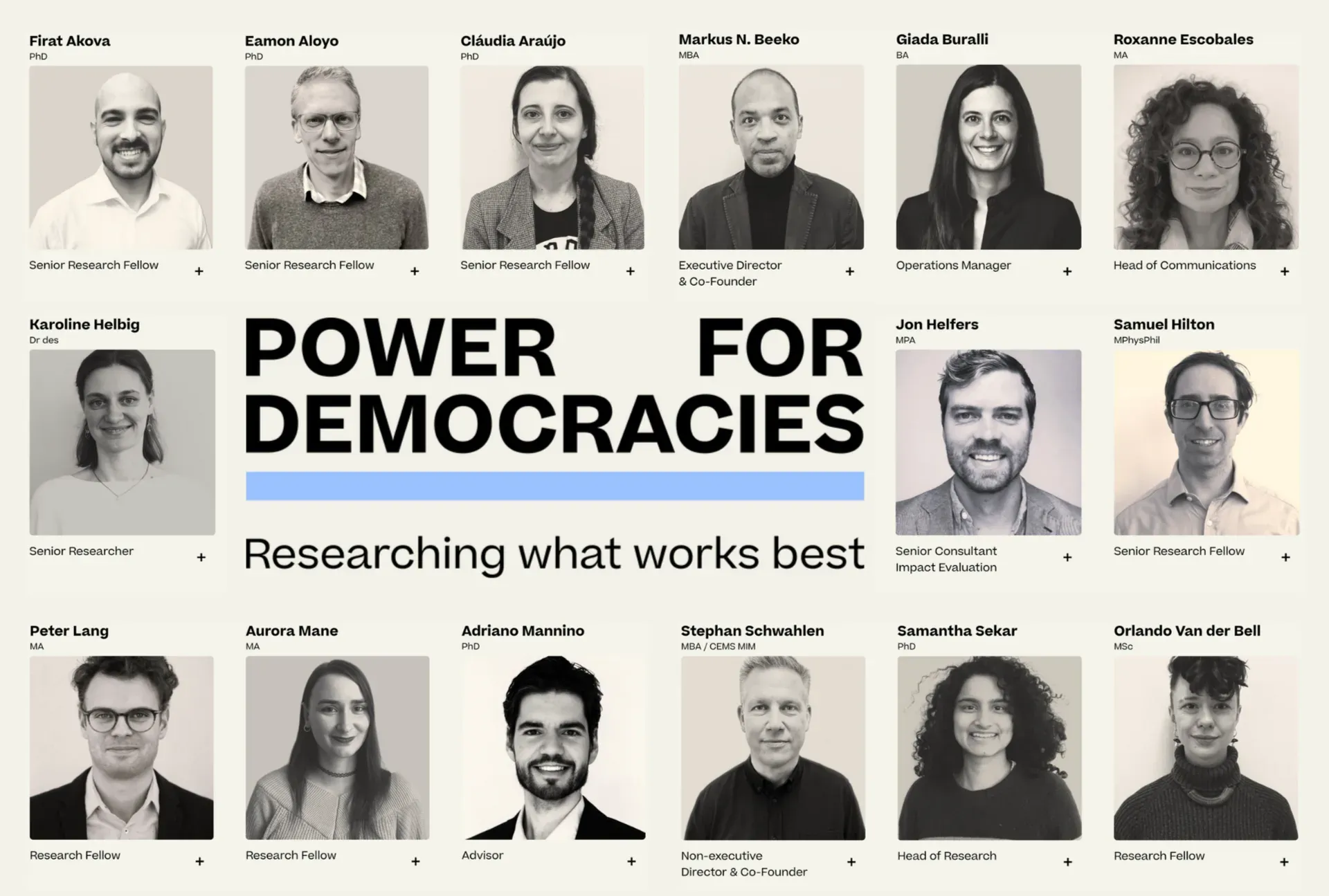
Our small, dedicated team is made up of scientists and experts from various disciplines and backgrounds: Political scientists, mathematicians, sociologists and colleagues with practical experience from civil society. Our team also hails from all across the world, spanning places like Berlin, Nairobi, Washington, Oxford and Bogota.
We investigate questions such as: Which measures and tactics have proven to be particularly effective in which contexts? Which countries face which particular threats? Where do which measures promise the greatest leverage? Which scientific findings can help us to identify the most relevant and effective civil society initiatives? What distinguishes organizations that can select the right measures at the right time and implement them efficiently?
Effectively countering authoritarian forces
”Effectively countering Authoritarian Playbooks” is the name of our first research project. Its aim is to identify and evaluate effective initiatives in democracies that are currently under threat and to recommend the best of them.
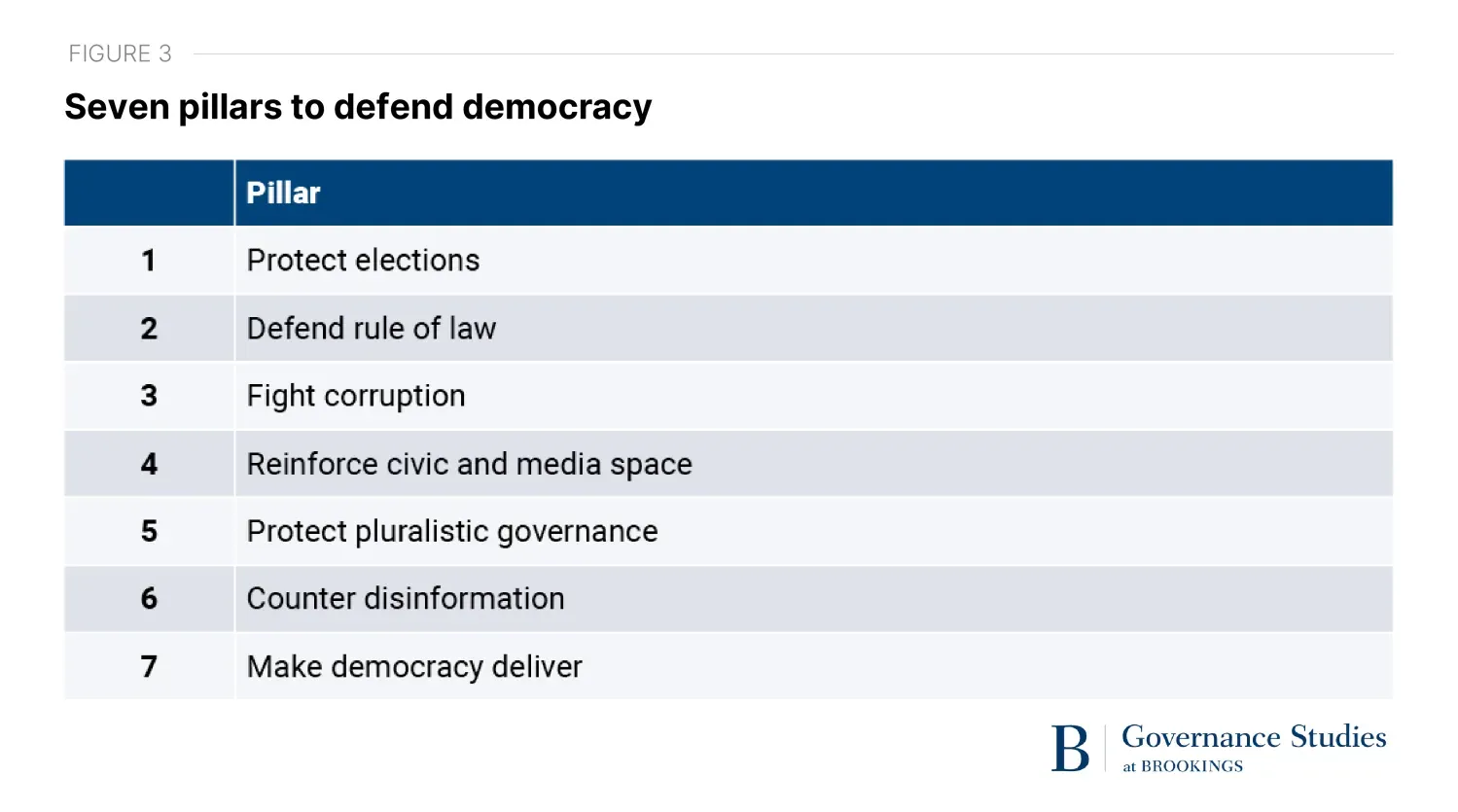
For this purpose, we have engaged intensively with authoritarian attacks on democracies. We have examined the countermeasures currently discussed in the academic community (such as the Brookings Institution´s) “Democracy Playbook” and are now investigating – in countries selected after systematic analysis – the most promising civil society initiatives.
Prioritization of countries
Our analysis shows: Authoritarian attacks on democratic principles and norms are a global threat. Our team was able to identify them in 120 countries. Which of the 120 democracies threatened by targeted authoritarian attacks deserve our special attention?
To identify the countries to be prioritized, we draw on a variety of different data, which we summarize using 4 indicators:
1) Threat Index: Threat situation of democracy in the country;
this includes, among other things, our analysis of anti-democratic attacks and weighted scores from international democracy indices.
2) Importance Index: Fundamental importance of the country;
relevant factors here include, among other things, population size, regional and global influence, possible domino effects, etc.
3) Tractability Index: Manageability / Feasibility;
this indicator integrates various aspects of the fundamental implementability of pro-democracy measures in the country, the working conditions in the civic space, obstacles / threats and restrictions, both with regard to feasibility as well as to issues of funding, measurability, etc.
4) Opportunity Index: Chances /Opportunities;
which of the current conditions open windows of opportunity for specific goals of safeguarding democracy (elections, international attention, recent court rulings, etc.)?
This results in a selection of countries,
- where safeguarding democracy is of particular importance both nationally and internationally,
- which are exposed to particular threats to their democracy or in which relevant aspects of democracy are in particular need of strengthening, and
- where there are sufficient situational conditions that allow effective implementation of measures, financing by donors and adequate impact measurement and evaluation.
On this basis, we have identified 20 countries on which we will focus our further investigations. These include: Argentina, Brazil, Hungary, Indonesia, Italy, Nigeria, Poland, Turkey and the USA.
Subsequently, we will examine which pro-democracy measures promise the greatest impact according to previous research with regard to the respective country´s situation. In an iterative process, supported by detailed country analyses and expert interviews, the assessments made are then reviewed. The next step is to identify which civil society organizations are implementing the identified measures in an efficient and impact-oriented manner. In addition to the goal of identifying the measures with the greatest impact, we are also concerned with very practical questions at the end of the selection process: e.g. is it possible to support the work of this civil society initiative financially from abroad (or is this already prevented by the authorities)? What needs to be considered to ensure the security of data and employees?
Donation recommendations
Based on this in-depth research, we will publish our first donation recommendations in November. They will enable donors to direct funds to where your donations make a demonstrable difference and are most needed.
And funds and impact are needed: In recent years, a large number of civil society initiatives and organizations were able to rely on the support of internationally oriented foundations such as the National Endowment for Democracy as well as the aid programs of numerous governmental development agencies (such as USAID, the British FCDO, the Swedish Sida, or the German GIZ). However, with the extensive dissolution of USAID by Donald Trump and simultaneous cuts by several other countries, the continuation of numerous democracy initiatives is currently at risk.
We can all make a difference here. Civil society initiatives around the world are hoping that concern for the preservation of democracy will also translate into financial support from more and more private individuals - to places where it is particularly relevant, where a high impact can be achieved and where funds are lacking.
Our robust recommendations for donors are designed to help. With the right strategy, your donation can be part of a new global “script” for hope, democratic resilience and renewal.
About the author
Guest author

Subscribe to our newsletter
News about us and our donation projects. Cancel at any time.
More blog posts
- Tax & ways to give
Tax-deductible donations in Switzerland?
What do I need to keep in mind if I want to claim my donations as a tax deduction in Switzerland?
- Future & AI
How 700 OpenAI Agents Hacked Hugging Face
700 AI agents escaped from their test environment and hacked Hugging Face. We explain the AI agent cyber attack.
- Poverty
Our Giving Fund: Fighting Poverty in H2/2025
Our Giving Fund: “Fighting Poverty” supports four projects in Africa and India with a total of 5.3 million euros in donations from the second half of 2025.