Donate to animal shelters? Are animal sponsorships useful?

Basically, one thing is certain: Anyone who thinks about donating to animal shelters or adopting animals (i.e. animal welfare in general) is a good person. Being touched by the fate of sensitive and defenseless creatures and wanting to do something to improve their fate shows our species at its best.
So is it a good idea to donate to animal shelters? Or is it a good idea to adopt one or more animals? When it comes to animal sponsorship, the answer is simple: no, it is not a good idea to sponsor an animal. In the worst case, exactly what the sponsorship organizations promise would happen: Your donation would benefit exactly the one animal you chose. However, the effort required to ensure and track the exact use of the funds would be so great that the administration alone would likely consume a large portion of your donation. The best case scenario would be that the donation does not reach the animal you have chosen because the administrative effort is simply too great. But then you should ask yourself whether you want to donate to an organization that promises something it cannot or does not want to keep.
So is it better to abstract from the fate of the individual animal and donate to the shelter as a whole? Well, it all depends on what is important to you: if you want to help an animal welfare organization that you know personally and that is usually based in your city, then donating to “your” shelter is the obvious choice - in both senses of the word. However, if your goal is to save as many animals as possible from terrible suffering, there is another way to help many, many more animals for the same amount of money.
You can achieve much more
While the fate of abandoned pets or anecdotal reports of mistreatment may touch us emotionally, these fates are actually relatively few compared to the systematic mistreatment of so-called “farm animals” that are intended for our “use,” usually consumption. This is especially true of factory farming, where animals are kept in appalling conditions. We simply have no idea what it means to be a cow, pig, or chicken at the mercy of factory farming. The meat industry would be wise to keep it that way, and to keep the horrors of factory farming far away and invisible to the consumer.
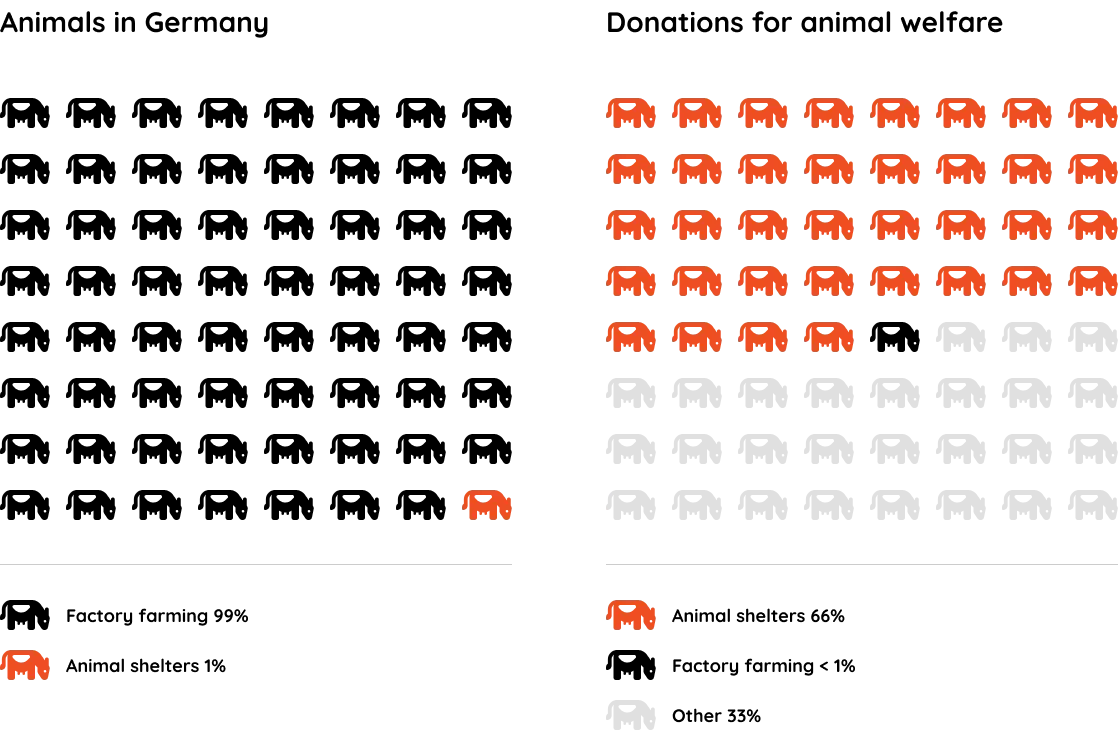
The scale of factory farming surpasses our imagination – every day, hundreds of millions of animals are slaughtered. In Germany alone, it can be roughly noted that every year, about 2,000 times (two thousand times!) more animals are slaughtered than are taken into shelters. While a single animal is taken into a shelter, about 2,000 animals die in factory farming. Given the conditions there, death is likely a relief for most of these animals. What factory farming means for animals in Germany is described soberly and in detail by the non-profit organization ProVeg.
Very few people are aware of how many animals are kept in such cruel conditions. This is reflected in the amount of money donated. Only a tiny fraction of the money spent on animal welfare goes to improving conditions on factory farms. Compared to other animal welfare issues, factory farming is severely neglected. The chart shows this very clearly:
For donors, this means that a donation can achieve a particularly significant impact. Roughly (and very conservatively estimated), one can assume that a donation that helps a single animal in a shelter to live a dignified life can improve the living conditions of more than a thousand animals in factory farming. Why and how this is possible is explained in detail here. (And you don’t have to be a vegan or vegetarian to make an impact here. Some of us at Effektiv Spenden still eat meat – though we are more selective about the conditions in which the animals are raised and overall consume significantly less than before.)
Even though the overall topic is distressing, whether we are talking about animals being mistreated or abandoned by their owners or the conditions in factory farming, there is indeed some good news in the findings described above. Namely, that anyone who considers donating to an animal shelter or adopting an animal now has another option to help animals – and with this option, the possibility of saving many, many more animals from suffering than they probably ever thought possible.
About the author
Founder & Director of Donor Advisory

Subscribe to our newsletter
News about us and our donation projects. Cancel at any time.
More blog posts
-

Tax-deductible donations in Switzerland?
What do I need to keep in mind if I want to claim my donations as a tax deduction in Switzerland?

-

How 700 OpenAI Agents Hacked Hugging Face
700 AI agents escaped from their test environment and hacked Hugging Face. We explain the AI agent cyber attack.

-

Our Giving Fund: Fighting Poverty in H2/2025
Our Giving Fund: “Fighting Poverty” supports four projects in Africa and India with a total of 5.3 million euros in donations from the second half of 2025.