The Humane League
The end of factory farming

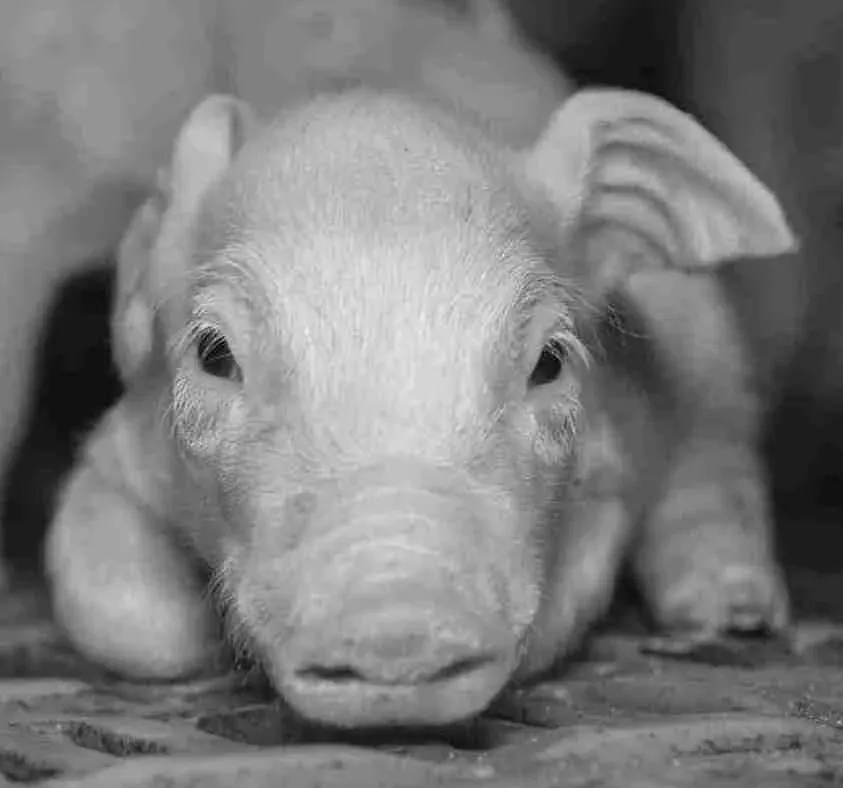
The goal of The Humane League (THL) is to end the abuse of animals raised for food.
THL focuses specifically on campaigns aimed at encouraging companies to adopt higher animal welfare standards. In addition, the organization promotes the international exchange of knowledge and strategic cooperation with other animal rights groups. It maintains a large network of activists, whom it supports through training and mentorship and enlists in its campaign work.
The problem
In recent decades, demand for animal products has skyrocketed worldwide. Since 1960, global meat consumption has increased fivefold and now stands at over 350 million metric tons.[1] and more than 80 billion land animals are raised and slaughtered each year for food production.[2] This demand for meat and other animal products has given rise to an industry worth over 300 billion euros.[3]
Since meat is expected to become cheaper and cheaper, companies are under great pressure to reduce production costs as much as possible. As a result, cheap, mass-scale meat production has been perfected over the past few decades. While in 1960, a German citizen still had to work two hours and eleven minutes to afford a fried chicken, by 2019 it took only twelve minutes to earn enough to buy one.[4]
Enormous price pressure ensures that every stage of production—including breeding, housing, feeding, and slaughter—is optimized down to the last detail to keep costs as low as possible. The animals’ quality of life is a secondary consideration in these processes. As a result, the vast majority of these animals live under agonizing, inhumane conditions. Chickens, which make up the vast majority of slaughtered animals, suffer particularly severely. For example, broiler chickens are kept at a density of 24 chickens per square meter, with up to 60,000 of their kind in a single facility.[5] Since chickens live in complex social hierarchies, but can only distinguish between up to 100 chickens individually, this leads to stress and aggression between them as stable hierarchies cannot be formed. Laying hens often have their beaks clipped without anesthesia to prevent mutual injury due to high stress levels. The tip of the beak is an important tactile organ, with an intense blood supply and nerves running through it, making removal extremely painful.
In addition to improving animal welfare conditions, an obvious solution would be to significantly reduce the consumption of animal products. However, despite decades of activism by animal rights and environmental organizations, the number of people who are vegetarian or vegan has hardly changed to this day. In most countries, meat consumption continues to rise—for example, in the United States.
The solution
Since it is very difficult to change people’s individual consumption habits—especially when this seems to involve making sacrifices—THL focuses on influencing the food industry and policymakers. For example, it seeks to convince companies to abandon particularly cruel farming practices, such as keeping laying hens in cages. By focusing on chickens, this approach is particularly effective because it addresses an issue that affects a very large number of animals.
Through corporate commitments, the conditions for animals in factory farming can be greatly improved. If a company is not willing to make changes voluntarily, public campaigns raise consumers’ awareness of the animals’ conditions, thereby further increasing the pressure. The tactics used vary depending on the context, ranging from advertising campaigns to protests outside store locations, leaflets, and petitions.
THL is also working to positively influence the legal framework governing animals. Although implementing a legislative change can take much longer than other interventions, the effects of such a change are much more sustainable and directly impact the entire industry, not just individual companies.

The impact
THL was founded in 2005 and has been very successful in convincing companies to stop using cruel farming practices. THL and its partner organizations have persuaded over 350 companies in the U.S. and over 2,700 worldwide to voluntarily commit to phasing out eggs from caged hens—including well-known corporations such as McDonald’s, Burger King, Starbucks, and Walmart.[6] THL closely monitors their progress in implementing these measures. As a result, they significantly improve the lives of tens of millions of chickens each year.
To share its expertise in the area of corporate campaigns and make the global animal rights movement more effective, THL is also involved in coordinating various animal rights organizations. To this end, they have established the Open Wing Alliance founded. More than 100 animal welfare organizations are now members of this alliance. Through this initiative, THL promotes the exchange of strategies and also helps fund Open Wing Alliance member organizations around the world through a grant program. In addition, THL builds the movement’s capacity by recruiting, mobilizing, and training activists. THL trains and supports volunteer activists and university groups. These efforts make THL’s campaigns even more effective, as they enable THL to quickly mobilize a large number of people to, for example, support a petition.
Our Partner Animal Charity Evaluators,, which evaluates highly effective animal welfare organizations, has recommended The Humane League as a top organization since 2014.
Blog articles
- Animals
Our giving fund: Reducing animal suffering in H2/2025
Our donation fund supports The Humane League and Sinergia Animal in H2/2025.
- Animals
Our Giving Fund: Improving Animal Welfare in H2/2024
This time our giving fund supports Sinergia Animal, The Humane League, & Animal Policy International.


External evaluation
THL in the media
- The Humane League Works To Free Factory Farm Animals From Horrid Conditions. Forbes. 2023.
- Want to help animals? Here's where to donate your money. Vox. 2022.
- Why California's 'great bacon crisis' has yet to arrive. The Guardian. 2022.
- Cal-Maine Steps Up Investment to Meet Demand for Cage-Free Eggs. The Wall Street Journal. 2022.
- The biggest animal welfare success of the past 6 years, in one chart. Vox. 2021.
- KFC first UK fast food chain to promise better chicken welfare standards. BBC. 2019.
- Supporting animal charities can be far more than a pet project. Financial Times. 2019.
- Giving in the Light of Reason. Stanford Social Innovation Review. 2018.
Sources
[1] ↑ All meat used for direct human consumption, 1961 to 2022. Global Food Data Explorer by Our World in Data. https://ourworldindata.org/explorers/global-food?tab=line&Food=Meat%2C+total&Metric=Allocated+to+human+food&Per+capita=false&country=~OWID_WRL. Last accessed in December 2025.
[2] ↑ Animal Welfare Explorer. Our World in Data. https://ourworldindata.org/explorers/animal-welfare.
[3] ↑ Processed Meat – Worldwide. Statista. https://de.statista.com/outlook/40020000/100/fleisch-wurstwaren/weltweit. Last updated in December 2025.
[4] ↑ Kaufkraft der Lohnminute. Deutschland in Zahlen 2020. Institut der deutschen Wirtschaft Köln. https://www.uvb-online.de/de/system/files/iw_deutschland_in_zahlen.pdf. 2020.
[5] ↑ Masthühner. Albert Schweitzer Stiftung für unsere Mitwelt. https://albert-schweitzer-stiftung.de/massentierhaltung/masthuehner. Last updated in February 2025.
[6] ↑ Cage Free Corporate Commitment Tracker with Hens Impacted. The Humane League. https://docs.google.com/spreadsheets/d/1pkVoUFOoM5gYtzsQ1bE_aNFaI9YctoY1fBHo-DMAqw8/edit#gid=0. Retrieved November 2023. See also Kelly Myers. We want to change the lives of 6.7 million birds - here's how. https://thehumaneleague.org/article/cage-free-goal. April 2023.