New Incentives
Vaccinations for children

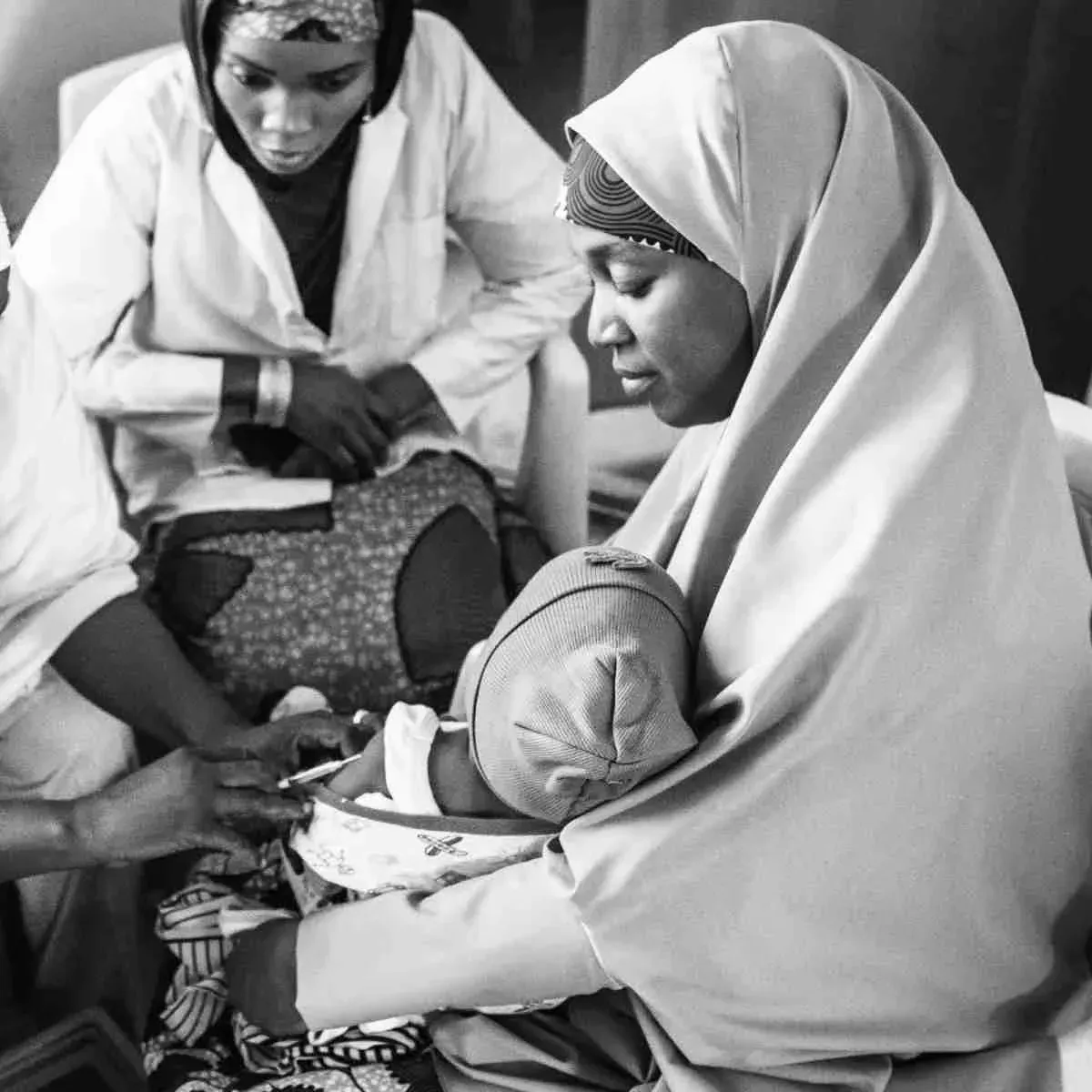
Vaccines for children prevent between three and a half and five million deaths worldwide every year. They are considered one of the most cost-effective measures in the field of child health.
New Incentives offers families in Nigeria small financial incentives to bring their children to clinics for routine vaccinations. This increases vaccination rates among children, prevents disease, and saves children’s lives.
The problem
Vaccinations are a global success story and save millions of lives every year. The World Health Organization (WHO) describes them as one of the best health investments money can buy.[1] However, despite enormous progress, vaccination rates worldwide have not improved in recent years. The COVID-19 pandemic placed a heavy burden on health systems in 2020 and 2021, even leading to dramatic setbacks in some cases. Although there are signs of recovery, 14.5 million children worldwide did not receive a single vaccination in 2024.[2]
In Nigeria, 33% of all children will not have received all recommended vaccinations by 2024.[3] With 115 deaths per 1,000 live births, Nigeria had the second-highest mortality rate in the world for children under five in 2024. (By comparison, the rate in Germany is less than four.) In absolute terms, Nigeria actually has the highest number of deaths among children under five. The country is home to about 3% of the world’s population, but accounts for about 16% of all deaths worldwide among children under five.[4] Low vaccination rates are a major reason for this—an estimated 38% of deaths among children under five are due to vaccine-preventable diseases.[5]
Poor people living in remote rural areas often have little access to healthcare. In Nigeria, routine vaccinations for children are offered free of charge in state clinics. However, parents often cannot afford the trip to the clinic—which can take half a day or longer—due to transportation costs and potential loss of income. And to complete the full routine vaccination schedule, this round trip to the clinic must be made six times within the first year of a baby’s life.
The solution
In collaboration with government clinics and in conjunction with existing programs in Nigeria, New Incentives offers parents small cash rewards, known as “conditional cash transfers”, when it is confirmed that their child has received the latest vaccinations. New Incentives focuses on the regions with the lowest immunization rates in northern Nigeria. There, fewer than one in three children receive all the recommended vaccinations. A quarter of children are not vaccinated at all.[5]
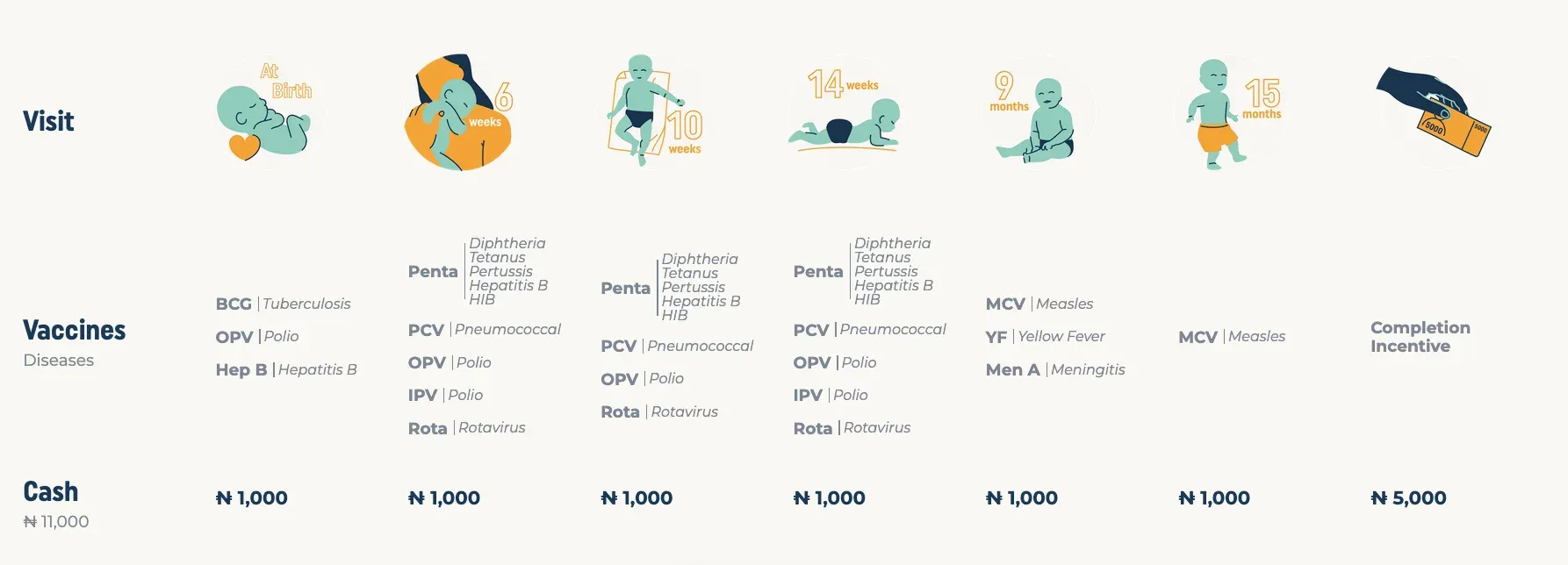
The cash rewards, which are paid out during six visits to the clinic in the child’s first year of life, amount to 1,000 naira each, totaling around €3.60 or CHF 3.33. This small amount is sufficient to cover transportation, medication, food, and lost income for the families. In addition, New Incentives pays parents 5,000 naira when their children have completed the entire routine vaccination schedule, bringing the total incentive to 11,000 naira (≈€6.60 / CHF 6.10).
The impact
New Incentives developed its program based on a series of studies that show, among other things, that conditional cash transfers can improve health behavior[7] and that small incentives can significantly increase vaccination rates.[8] Taken together, the research suggests that small cash incentives can be a highly cost-effective way to increase immunization rates in areas with low rates.
Since the specific model used by New Incentives and the local context in northern Nigeria had not yet been evaluated, the organization had its model thoroughly tested in a randomized controlled trial. The study found clear evidence that the program significantly increases vaccination rates.[9]
Based on the findings that vaccine-preventable diseases are a major cause of child mortality in northwestern Nigeria and that vaccines effectively prevent disease, the GiveWell research initiative is convinced that the New Incentives program can contribute to a significant reduction in child mortality in northwestern Nigeria. GiveWell estimates that with every donation of USD 4,500 (≈€3,900 / CHF 3,600), New Incentives saves the life of one child—that is, ensures that a child remains alive who, statistically speaking, would otherwise have died from an infectious disease without vaccination.[10]
The organization
New Incentives was founded in 2011 by Svetha Janumpalli in the USA. Svetha founded New Incentives to familiarize the nonprofit sector with conditional cash transfers, which are among the most researched, evidence-based instruments of development cooperation. For her work, Svetha was named one of Forbes’ “30 Under 30” social entrepreneurs in 2012 and was the winner of the Women Deliver Social Enterprise Challenge in 2013.
Her organization, New Incentives, has impressively scaled up its work to support vaccination campaigns in Nigeria in recent years. The team now consists of over 3,100 employees, more than 2,700 of whom work in Nigeria. In 2022, New Incentives reached its millionth child. Since its formation, New Incentives has enrolled over 6 million young children, disbursed approximately 26 million cash transfers, and encouraged over 90 million vaccinations. They regularly publish new figures on their website.
GiveWell has supported New Incentives since 2014 and has listed the organization as a “top charity” since November 2020.
Blog articles
-
Our Giving Fund: Fighting Poverty in H2/2025
Our Giving Fund: “Fighting Poverty” supports four projects in Africa and India with a total of 5.3 million euros in donations from the second half of 2025.

-
A day with a mobile vaccination team in Nigeria
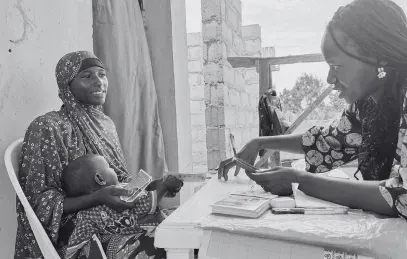
Helping to vaccinate babies in remote villages in Nigeria. In the guest article, New Incentives reports on a day with a mobile vaccination team.

FAQs
How much money do the parents receive?
The cash rewards amount to 1,000 naira for each of the first six vaccinations (at birth, after 6 weeks, 10 weeks, and 14 weeks) plus a bonus of 5,000 naira when all vaccinations are completed. In total, caregivers can receive up to 11,000 naira (approx. €6.60 / CHF 6.10) if the child receives all doses of the routine vaccination schedule.
What distinguishes New Incentives from traditional development cooperation (formerly development aid)?
New Incentives focuses on applying evidence-based methods to program design. For example, the program is designed to use conditional cash transfers, an approach that has proven effective in influencing health behaviors. They focus on vaccinations and operate in northwestern Nigeria, where less than one-third of young children are fully vaccinated, leading to devastating disease outbreaks. And they make operational decisions internally based on data to increase the program’s effectiveness.
How does New Incentives prevent fraud?
Curbing fraud is a key task for New Incentives. The organization has comprehensive procedures and systems in place to prevent and detect fraud. Every payment is checked after transfer. In addition, New Incentives regularly conducts unannounced program audits and has a robust data analysis system that it continuously develops based on the insights gained. They adhere to strict standards for the recruitment, training, and management of their staff.
External evaluation
New Incentives in the media
- The (modest) price of protection: Conditional cash transfers boost vaccination in Nigeria. GAVI VaccinesWork. June 2022.
Sources
[1] ↑ Vaccines and immunization. WHO. https://www.who.int/health-topics/vaccines-and-immunization#tab=tab_1. As of December 2025.
[2] ↑ Immunization coverage. World Health Organization (WHO). https://www.who.int/news-room/fact-sheets/detail/immunization-coverage. As of December 2025.
[3] ↑ Impact of vaccine-preventable diseases. GiveWell. https://www.givewell.org/charities/top-charities/citations#Impact_of_vaccine-preventable_diseases. As of December 2025.
[4] ↑ UNICEF Data Warehouse. UNICEF. https://data.unicef.org/resources/data_explorer/unicef_f/?ag=UNICEF&df=GLOBAL_DATAFLOW&ver=1.0&dq=WORLD+NGA+DEU.CME_MRY0T4+CME_TMY0T4._T.&startPeriod=2017&endPeriod=2025. As of December 2025.
[5] ↑ Data for 2021 for the following causes of death: diarrhea, lower respiratory diseases, measles, tetanus, tuberculosis.
UN Inter-agency Group for Child Mortality Estimation (IGME). https://childmortality.org/causes-of-death/data/estimates?d_refArea=NGA&type=FRACTION&ifex=CAUSE_OF_DEATH&cause=MALARIA.
See also: Villavicencio et al. (2024). Global, regional, and national causes of death in children and adolescents younger than 20 years: an open data portal with estimates for 2000–21. The Lancet Global Health 12(1), e16-e17. https://www.thelancet.com/journals/langlo/article/PIIS2214-109X(23)00496-5/fulltext
[6] ↑ National Bureau of Statistics (NBS) & United Nations Children’s Fund (UNICEF) (2022). 2021 Multiple Indicator Cluster Survey (MICS) & National Immunization Coverage Survey (NICS) – Survey Findings Report. https://www.unicef.org/nigeria/media/6316/file/2021%20MICS%20full%20report%20.pdf.
[7] ↑ See, for example, Bastagli et al. (2016). Cash transfers: what does the evidence say? ODI Research Reports. https://odi.org/en/publications/cash-transfers-what-does-the-evidence-say-a-rigorous-review-of-impacts-and-the-role-of-design-and-implementation-features/.
[8] ↑ Banerjee et al. (2010). Improving immunization coverage in rural India: clustered randomized controlled evaluation of immunization campaigns with and without incentives. BMJ, 340:c2220. https://doi.org/10.1136/bmj.c2220
[9] ↑ IDinsight (2020). Impact of Conditional Cash Transfers on Routine Childhood Immunizations in North West Nigeria – Final Report. https://files.givewell.org/files/DWDA%202009/NewIncentives/IDinsight_Impact_Evaluation_of_New_Incentives_Final_Report.pdf
[10] ↑ Impact metrics for grants to GiveWell's top charities. GiveWell. https://www.givewell.org/impact-estimates#Impact_metrics_for_grants_to_GiveWells_top_charities. As of December 2025.
See also: 2023 GiveWell cost-effectiveness analysis — version 4. GiveWell. https://docs.google.com/spreadsheets/d/18ROI6dRdKsNfXg5gIyBa1_7eYOjowfbw5n65zkrLnvc/edit#gid=1176773164.