Future Cleantech Architects
Innovative technologies for climate neutrality
Future Cleantech Architects (FCA) is a non-profit climate innovation think tank based in Germany that promotes the development of innovative, but so far neglected technologies to drastically reduce industrial greenhouse gas emissions. FCA focuses exclusively on high-impact innovations in neglected sectors that are difficult to decarbonize, such as cement and steel, aviation and shipping, or long-term energy storage.
What is special about FCA’s approach is that the organization not only takes on advocacy for these technologies at a political level, where it campaigns for the most effective use of taxpayers’ money for innovation, but is also itself part of research consortia for the development of these technologies. Giving Green, a recognized evaluator of high-impact climate initiatives, lists Future Cleantech Architects as one of six top recommendations for climate action.
The problem
In order to achieve the Paris climate targets, energy systems worldwide must be largely decarbonized by the middle of the century. The International Energy Agency (IEA) has seen significant progress in recent years. However, it estimates that a third of the technologies required to achieve this have yet to be developed
In industries such as cement, steel or aviation, decarbonization is particularly difficult because many industrial processes cannot simply be electrified. For example, if the process energy in cement production, which is responsible for 5% of global CO2 emissions, is produced in a carbon-neutral manner, the resulting CO2 emissions are still only slightly reduced, as they largely stem from the necessary chemical reaction itself.[2] The innovation gaps are greatest in these so-called “hard-to-decarbonize” sectors—even though innovation could make the biggest difference there.
The solution
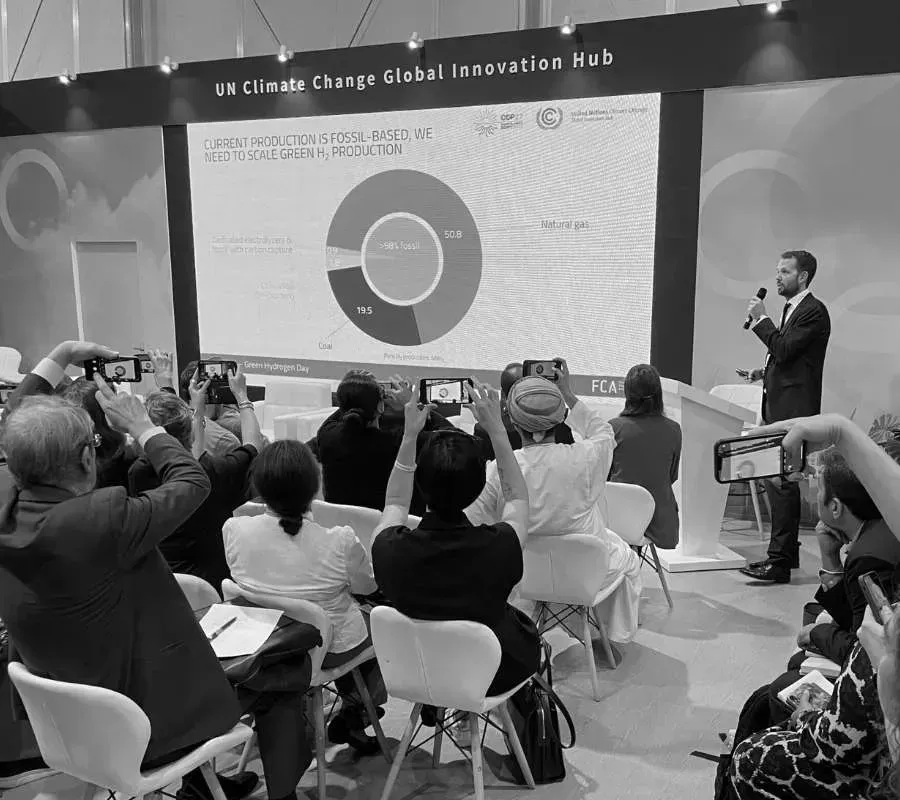
This is exactly where Future Cleantech Architects comes in. The FCA experts work together with leading representatives from research, industry, politics and international organizations - such as the United Nations and the World Economic Forum - to promote innovation. FCA regularly presents its assessments, for example at the UN World Climate Conference advises members of the European Parliament and the Bundestag, and publishes research findings as Multilingual factsheetsas political briefings and technical reports. Under the title “Coffee & Cleantech” the FCA team organizes short technical briefings for policymakers in Berlin and Brussels on a regular basis. As early as 2021, FCA co-hosted the UNIDO “Global Call for Innovative Solutions in Cleantech and Sustainable Land Management” together with the UN specialized agencies UN Climate Change and UNCCD. Since then, FCA has been organizing the ambitious “Future Cleantech Festival” in Remscheid, for the fourth time in June 2026.
FCA closely accompanies the development of promising innovations and provides advice. If FCA is convinced by an idea, the organization shares its observations and knowledge with decision-makers in politics and business. In the field of research, FCA works actively with leading research centers such as the German Aerospace Center, Forschungszentrum Jülich and the Fraunhofer-Gesellschaft.
The impact
In Europe in particular, this type of support and advocacy for climate technology innovation is very promising but still neglected. FCA not only supports political decision-making processes, but also actively participates in research consortia in order to promote the accelerated application of the necessary innovations.
The FCA’s staff, with years of experience in clean energy generation, has already been able to advise German and European policymakers, influence legislation (e.g., by anchoring higher quotas for breakthrough technologies in European member states), and provide important impetus for climate action at the UN level.
For example, FCA is working with ThyssenKrupp and the German Aerospace Center on a project using solar energy and carbon capture to minimize CO2 emissions from cement production. In this way, FCA experts apply their wealth of experience directly to research and industry.
FCA also curates the Handelsblatt series “Green Ideas that Change the World”. Each month a neglected technology is presented on a double page in the Handelsblatt print edition. The series has already reached nearly 13 million readers.
The organization
Future Cleantech Architects was founded in 2020 by Dr. Peter Schniering in Remscheid, North Rhine-Westphalia, Germany. Peter holds a doctorate in climate policy and advised the International Energy Agency in Paris and the Secretariat of the United Nations Framework Convention on Climate Change (UNFCCC) before founding the think tank. He has worked on renewable energy technologies for Roland Berger Strategy Consultants and is a member of the World Economic Forum’s advisory board on climate technology.
In the meantime, the organization has 16 employees and is represented in five European countries. Since spring 2023, for example, FCA has also had two female colleagues in Brusselswhich ensures permanent networking with the European political community. The team is supported by a Advisory Groupwhich is made up of top-class experts, for example from the United Nations, Forschungszentrum Jülich, the European Institute of Innovation & Technology (EIT) and companies such as EnBW.
Giving Green, a leading evaluator for effective climate initiatives, lists FCA as one of its six recommended top non-profits. In particular, it recognizes FCA’s work in hard-to-decarbonize sectors such as heavy industry, baseload power generation and aviation. The assessment highlights FCA’s deep technical expertise and its meaningful influence on EU climate policy, as well as its contributions to the decarbonization of cement and hydrogen production. Giving Green particularly appreciates FCA’s potential to achieve sustainable progress in often neglected areas through targeted innovation.
According to our partner and evaluator Founders Pledge, FCA has exceeded expectations at improving the European climate policy response. Most notably, the organization has helped shape key legislation at the EU level and advised policymakers how the EU can achieve the highest return on investment when supporting research and development for clean energy technology.
Blog articles
- Climate
FCA cooperates with Handelsblatt
The top recommendation for effective climate protection "Future Cleantech Architects" scientifically accompanies a new greentech series in the Handelsblatt.

External evaluation
- Giving Green evaluation and recommendation (updated November 2025).
- The evaluation of Founders Pledge: Navigating the changing landscape of climate philanthropy (2021).
FCA in the media
- Design efficiency can advance climate protection in the building sector. Tagesspiegel. 2025.
- Warum synthetisches Methan eine grüne Mogelpackung ist. Frankfurter Allgemeine Zeitung (€). 2024.
- Warum die deutsche Wasserstoffwirtschaft hinterherhinkt. DER SPIEGEL (€). 2024.
- Speed-Dating mit Klima-Start-ups: Was bringen Greentech-Innovationen? Handelsblatt Green & Energy Podcast from the Future Cleantech Festival in Remscheid. 2024.
- Future Cleantech Festival 2024 in Remscheid | Studiogespräch: Leonie Brand, stellvertretende Geschäftsführerin “Future Cleantech Architects”. WDR Lokalzeit. 28.05.2023.
- Remscheider Denkfabrik auf der Weltklimakonferenz in Dubai. WDR Lokalzeit. 05.12.2023.
- Porträt Peter Schniering (FCA Gründer und Geschäftsführer). Tagesspiegel Background Energy & Climate (€). 2023.
- Die heimlichen Klima-Helden im Ministerium. Point of view by Peter Schniering in the Tagesspiegel Background Energie & Klima. 2023.
- Greentech – Grüne Ideen, die die Welt verändern. Handelsblatt-Serie. 2023.
- Clean-Tech Innovation Is a Marathon Not a Sprint at ARC2023. BloombergNEF. 2023.
- Zement – die schmutzigste Industrie der Welt. ntv Klima-Labor 2023.
- Bauen. Planetary Podcast Episode 3. Podcast by brand eins and Planet A. 2022.
- The ARC Cleantech Innovation Festival 2022nd WDR Lokalzeit. 2022.
- Tech-Lösungen im Kampf gegen den Klimawandel. Peter Schniering in the WirklichGut podcast. 2022.
- Wie kann Mobilität klimafreundlich sein? mobiliTALK. Alliance for mobility of the NRW Ministry of Transport. 2022.
- UNIDO Global Call – innovative Lösungen in der Klimatechnologie. WDR local time. 2021.
- 3 ways to boost cleantech momentum in the post-COVID-19 era. World Economic Forum (WEF). 2020.
Sources
[1] ↑ Net Zero Roadmap: A Global Pathway to Keep the 1.5 °C Goal in Reach. International Energy Agency (IEA). https://www.iea.org/reports/net-zero-roadmap-a-global-pathway-to-keep-the-15-0c-goal-in-reach. September 2023.
[2] ↑ THE BASICS & THE GAPS: Cement. FCA Climate Innovation Factsheet Series #2. https://fcarchitects.org/content/the-basics-the-gaps-cement/. 2022 (German version of the factsheet here as PDF.) See also Dekarbonisierung der Zementindustrie. Umweltbundesamt. https://www.umweltbundesamt.de/sites/default/files/medien/376/dokumente/factsheet_zementindustrie.pdf. February 2020.