Germany Causes
< 2% of Global CO2


Germany is responsible for less than 2% of global greenhouse gas emissions, so even truly ambitious German climate policy would not help…
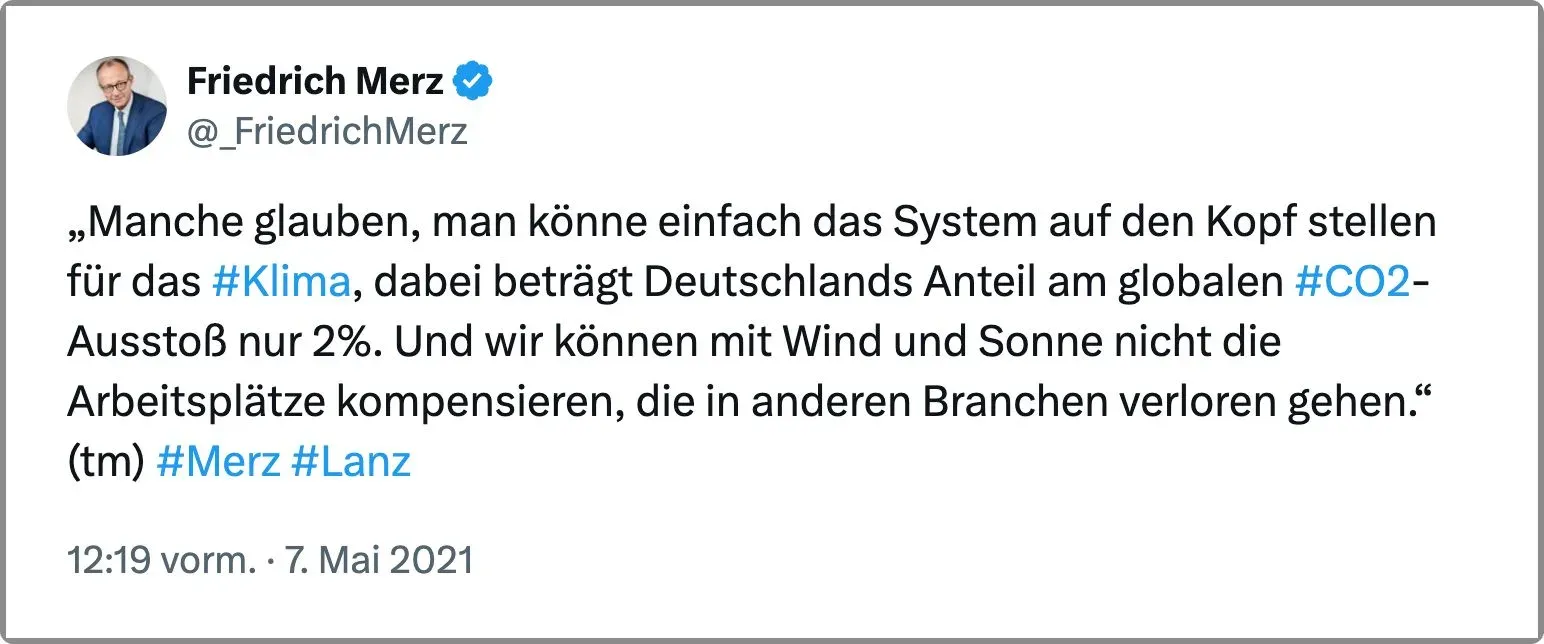
Many decision-makers have argued along these or similar lines in recent years, not least the future German Chancellor Friedrich Merz. By now I find it difficult to keep a cool head when I hear this “argument” and generally assume that people are not interested in gaining knowledge or even solving problems, but only in scoring points in the debate.
But for those who are really taking this serious, here are five reasons why a country’s current CO2 greenhouse gas emissions should not really be relevant to its climate policy.
1. per capita instead of per country
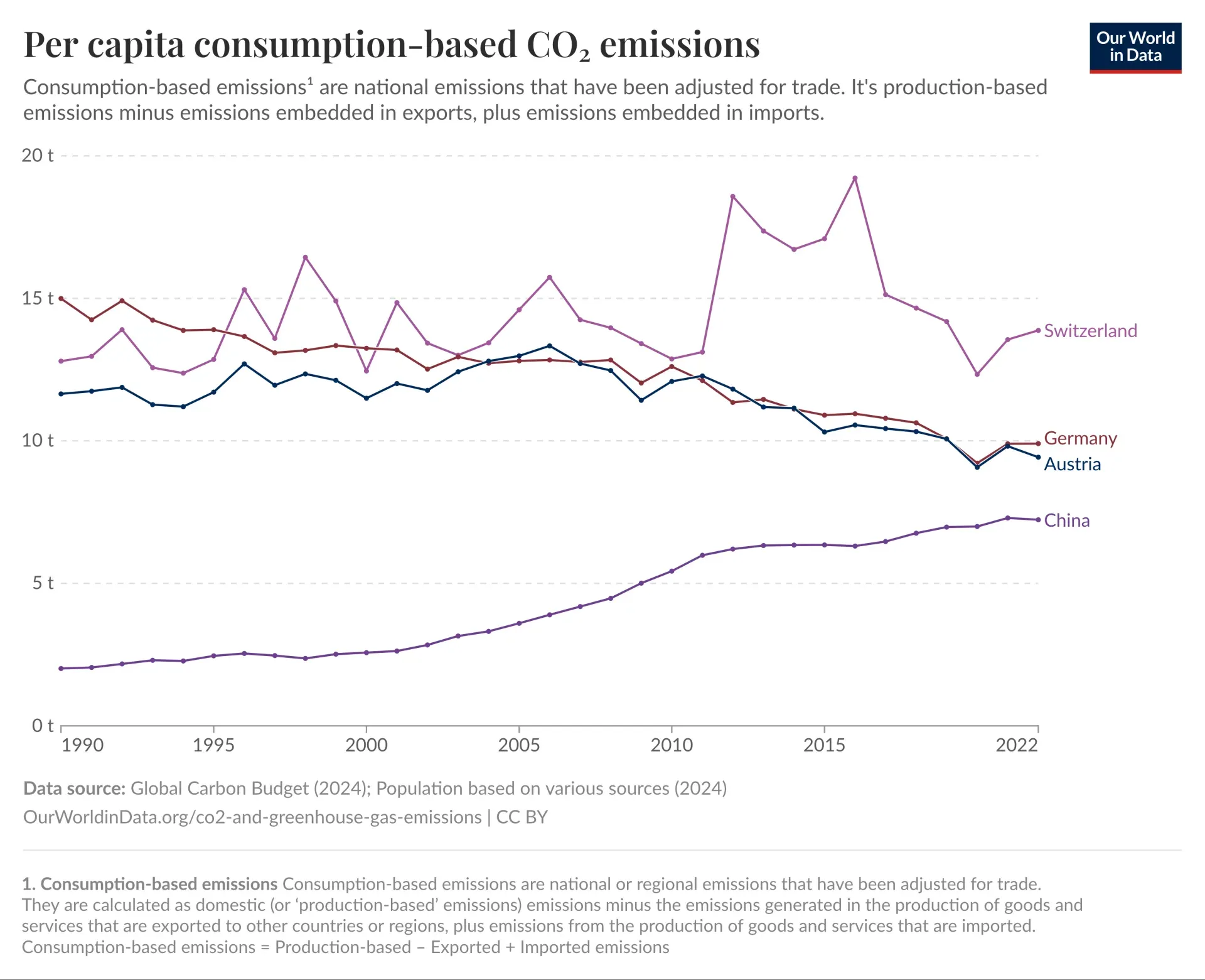
Of course, it doesn’t make sense to focus on the emissions of an entire country when it comes to deciding who is responsible. Instead, we should look at CO2 emissions per capita, and here Germany, Austria and Switzerland are not only ahead of China, but also more than 100% above the global average.
2. consumption instead of production
Many emissions are caused by imported products. In Germany and Austria, the consumption-based CO₂ emissions are around 40% higher than the officially reported figures. In Switzerland, they are more than 270% higher. What matters is what we consume, not just what we produce.
3. historical instead of current emissions
It seems extremely unfair to focus solely on current emissions instead of the historical total, since our prosperity was not created in the past year alone but is significantly based on industrial development over the last 200 years. According to this metric, Germany already accounts for more than 5% of global emissions.
4. achieving targets instead of playing the blame game
Even if the two largest emitters - China and the USA - were to stop emitting greenhouse gases altogether, we would not even be halfway to achieving the goal of reducing global CO2 emissions to zero. Everyone has to joins in, otherwise it cannot work, so even small countries cannot shrug off their responsibility.
5. ambitions instead of excuses
Instead of lamenting how much or how little Germany contributes to climate change, we should rather think about how we can achieve more. In doing so, we should not look too much inwards, but consider what measures could help to reduce global CO2 emissions. One approach would be to help new climate technologies achieve a breakthrough, which can then be rolled out worldwide. This is exactly what we have already done once, namely with the solar industry, as Ramez Naam impressively explains in this video:
By the way, this last point makes sense not only for countries but also for each of us personally. Instead of limiting ourselves to trying to offset our own CO₂ emissions, we should consider how to take ambitious action for global climate protection. In addition to personal behavioral changes, effective donations can be a powerful lever for climate action—especially when used to make essential climate technologies scalable and competitive. That’s exactly what the top climate organizations we recommend are working on.
About the author
Founder & Managing Director
More blog posts
-

Tax-deductible donations in Switzerland?
What do I need to keep in mind if I want to claim my donations as a tax deduction in Switzerland?

-

How 700 OpenAI Agents Hacked Hugging Face
700 AI agents escaped from their test environment and hacked Hugging Face. We explain the AI agent cyber attack.

-

Our Giving Fund: Fighting Poverty in H2/2025
Our Giving Fund: “Fighting Poverty” supports four projects in Africa and India with a total of 5.3 million euros in donations from the second half of 2025.