Helen Keller Intl
Saving lives with vitamin A

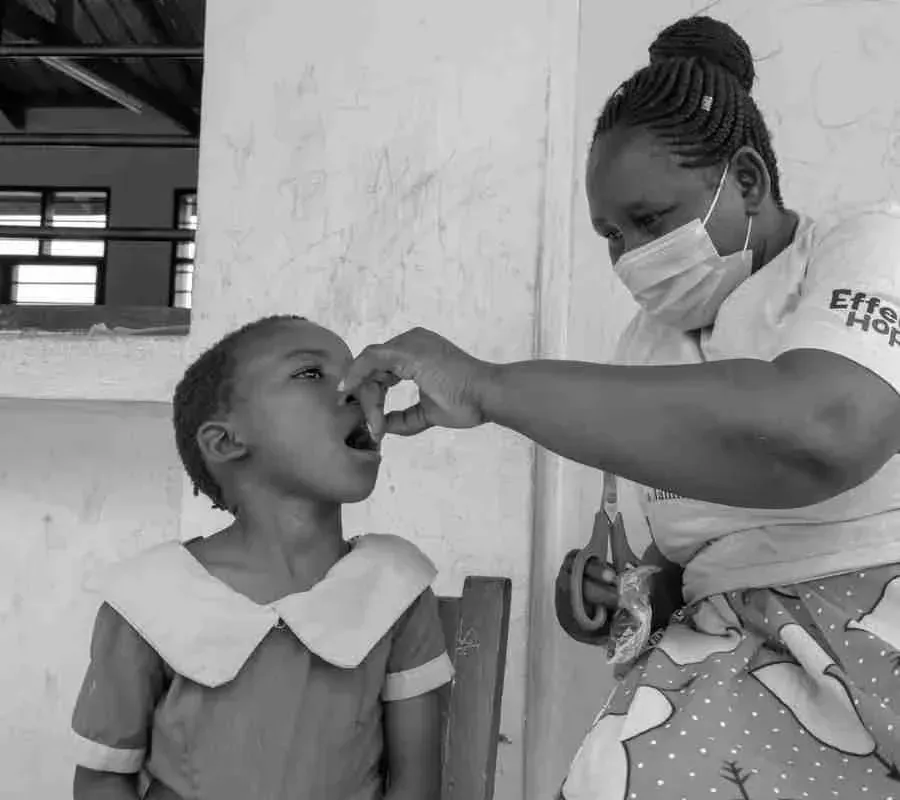
The vitamin A supplementation program run by the aid organization Helen Keller Intl (formerly Helen Keller International) saves the lives of young children in developing countries and protects them from blindness.
In recent decades, millions of children have died or gone blind as a result of vitamin A deficiency. Helen Keller International supports government programs that provide high-dose vitamin A capsules to at-risk young children every six months.
The problem
Vitamin A is important for the healthy development of children. It strengthens eyesight, prevents blindness and boosts the immune system so that children are strong enough to fight “normal” childhood illnesses such as colds, flu, malaria and diarrhea. For children who are not sufficiently supplied with vitamin A, these diseases can quickly become life-threatening. The Global Burden of Disease Project attributes over 200,000 deaths in children each year to vitamin A deficiency.[1]
In countries like Germany, vitamin A is a completely natural part of the diet—for example, in carrots, milk, egg yolks, and leafy vegetables. For many families living in poverty around the world, however, this is not the case. Sometimes these foods are not available, and even more often, they are too expensive for these families. According to the United Nations Children’s Fund (UNICEF), 140 million children worldwide who are at risk of vitamin A deficiency have no access to vitamin A supplements and are therefore vulnerable to serious illnesses.[2]
The solution
A single vitamin A capsule, administered to children twice a year during the first five years of their lives, can literally save their eyesight and their lives. And the total cost of a vitamin A capsule, its distribution, and the associated administrative costs is only about $1. Thus, a young child can be provided with vitamin A for about $2 per year, and the risk of premature death or blindness can be significantly reduced.[3]
In particularly vulnerable countries in Africa and Asia, Helen Keller International supports governments in providing high-dose vitamin A capsules every six months to young children at risk of vitamin A deficiency, in accordance with World Health Organization (WHO) recommendations.[4] In 2024, Helen Keller International distributed approximately 87 million vitamin A capsules.[5]
Specifically, this is carried out by nurses or trained social workers visiting households where children between the ages of 6 and 59 months live and administering the contents of the capsules directly into the children’s mouths. Depending on the child’s age, the capsules contain the amount of vitamin A recommended by the WHO—between 100,000 and 200,000 international units. This is roughly 100 times the recommended daily dose for children, and the vitamin can be stored in the liver for several months.

The impact
Numerous studies have shown that infant mortality can be significantly reduced by vitamin A supplementation programs. A meta-study updated in 2022 summarized the results of 47 individual studies covering nineteen different countries and more than 1.2 million children. According to the study, the administration of vitamin A reduces the risk of infant mortality by 12%. In particular, mortality due to diarrhea and respiratory diseases as well as measles was significantly reduced.[6] Accordingly, the study concludes that the administration of vitamin A is associated with a clinically significant reduction in morbidity and mortality in children.
In addition, GiveWell certifies that the aid organization Helen Keller Intl maintains high-quality ongoing monitoring of project activities and estimates that Helen Keller Intl can prevent one death from the effects of vitamin A deficiency for every $1,000–$8.500 (depending on the country).[7]
The organization
Helen Keller Intl’s vitamin A supplement program has been listed by GiveWell as one of four current “Top Charities” since 2017. The organization was founded back in 1915 by the deaf-blind author Helen Keller and the entrepreneur George A. Kessler.
Helen Keller International is currently working in more than twenty countries to address the causes of blindness, visual impairment, and malnutrition. The organization’s total budget in 2024 was approximately $124 million. The nutrition division, which includes vitamin A supplementation programs, had an annual budget of approximately $58 million, which, among other things, made it possible to provide about 44 million children in 14 African countries with two vitamin A capsules.[8]
FAQs
Who was Helen Keller?
Born in 1880, Helen Keller was an American author, political activist, and lecturer who lost her sight and hearing at the age of 19 months. She was the first deaf-blind person to earn a bachelor’s degree. She wrote several books, learned various foreign languages, and received, among other honors, an honorary doctorate from Harvard University. In 1915, she became a board member of the Permanent Relief War Fund, which was founded that same year and later renamed Helen Keller International.
Do the vitamin A capsules have any side effects?
In some cases, vomiting occurs up to 48 hours after taking the contents of the vitamin A capsule. Other side effects may include headaches, loose stools, irritability or fever. Overall, however, side effects are rare and do not lead to permanent damage.
In what areas is Helen Keller International still active?
In addition to its vitamin A supplementation programs, Helen Keller Intl supports a total of 73 million children and family members in twenty countries across Asia, Africa, Europe, and the United States in growing and eating nutritious foods, prevent malnutrition, build a strong immune system, gain access to life-saving medical treatments, and prevent and treat blindness and vision loss.
Are the donations really only used for the vitamin A supplementation program?
Based on the findings of the renowned research institute GiveWell, we recommend that you donate specifically to Helen Keller Intl's vitamin A supplementation program, as its effectiveness has been proven by independent scientific studies, and its outstanding cost-effectiveness has been demonstrated. In this regard, all donations are earmarked. It cannot be assumed that Helen Keller Intl will use fewer unrestricted donations for the Vitamin A Supplementation Program as a result, as the organization receives only a very small portion of unrestricted donations (approximately 5%) and these are largely used for fundraising and administrative costs.
External evaluations
- The Evaluation of GiveWell
- Overview by The Life You Can Save
Helen Keller Intl in the media
- The danger of complacency: Lost progress in vitamin A distribution. Bill & Melinda Gates Foundation. July 2019.
- Helen Keller International Treats Vitamin A Deficiencies. Borgen Magazine. January 2018.
- 12 Days Of Charitable Giving 2017: Helen Keller International. Forbes. December 2017.
Sources
[1] ↑ GBD 2017 Risk Factor Collaborators. Global, regional, and national comparative risk assessment of 84 behavioral, environmental and occupational, and metabolic risks or clusters of risks for 195 countries and territories, 1990-2017: a systematic analysis for the Global Burden of Disease Study 2017. The Lancet: Vol 392: 1923-1994. https://doi.org/10.1016/s0140-6736(18)32225-6. November 2018.
[2] ↑ More than 140 million children are at greater risk of illness because they are missing out on life-saving vitamin A supplements. UNICEF. https://www.unicef.org/turkiye/en/node/2531. May 2018.
[3] ↑ Helen Keller International’s Vitamin A Supplementation Program. GiveWell. https://www.givewell.org/charities/helen-keller-international#What_do_you_get_for_your_dollar. Last updated in January 2025.
[4] ↑ Guideline: Vitamin A supplementation in infants and children 6-59 months of age. World Health Organization. https://www.who.int/publications/i/item/9789241501767. July 2011.
[5] ↑ 2024 Annual Report. Helen Keller International. https://helenkellerintl.org/who-we-are/annual-reports/ Last accessed in December 2025.
[6] ↑ Aamer Imdad et al. Vitamin A supplementation for preventing morbidity and mortality in children from six months to five years of age. Cochrane Database of Systematic Reviews. https://www.cochranelibrary.com/cdsr/doi/10.1002/14651858.CD008524.pub4/full. March 2022.
[7] ↑ Helen Keller International’s Vitamin A Supplementation Program. GiveWell. https://www.givewell.org/charities/helen-keller-international#What_do_you_get_for_your_dollar. Last updated in January 2025.
[8] ↑ 2024 Annual Report. Helen Keller International. https://helenkellerintl.org/who-we-are/annual-reports/ Last accessed in December 2025.