Why and how I donate

In this guest post, Christoph Hartmann writes about why he donates and how he chooses the organizations he donates to. Christoph regularly talks to us about his donating decisions, so we asked him to share his thoughts here.
About five years ago, I was standing in line at Starbucks and couldn’t help but ask myself some uncomfortable questions: Instead of drinking this coffee, shouldn’t I donate the money? To whom? Yes, the coffee is Fairtrade, but wouldn’t it be better to buy non-Fairtrade coffee and donate the difference? If I donate the money anyway, are anti-poverty organizations the right ones, or should I be doing much more for climate change? That seems so urgent. Are donations the right approach at all, or should I rather change my consumer behavior, become politically active, get involved, try to change the system instead of working with the existing system?
Of course, the questions didn’t come out of nowhere. I had just graduated from college, started my first job, and suddenly had more money than I needed. This brought back memories of the book “Practical Ethics” by Australian philosopher Peter Singer. In it, he argues that because of the huge wealth gap between rich and poor countries, giving away, say, 10% of one’s gross income would make little difference to the living conditions of the rich, but would have an enormous impact on the recipients of the donations. As a student, these considerations seemed relatively theoretical, but with my first job, they suddenly became very practical: as a young professional, do I even count as “rich,” how much should I donate, and how do you actually choose organizations?
Today, some five years later, I would like to summarize my thoughts on the subject. Many of the thoughts stem from the Effective Altruism Movement, which has been dealing with these issues much longer and more intensively.
Why I donate: I am part of the global 1%
I donate because I believe that I can help others relatively much with little personal loss. The basis for this is the unequal distribution of money in the world on the one hand and the diminishing effect of money on satisfaction on the other:
The inequality of money is obvious, but a global perspective particularly helps me here. For example, if you earn the median per capita income of around €42,000 (about €30,000 after taxes) in Germany, you belong to the richest 2% globally according to this resource. You would then be earning about 28 times the median income worldwide. By donating 10% of your net income per year, you would have about €27,000 left, which would place you among the richest 3% globally and you would earn “only” 25 times the median income worldwide. From a purely financial perspective, we in Germany could simply give a bit, without being significantly worse off, but what does that mean for life satisfaction, especially since the cost of living in Europe is higher?
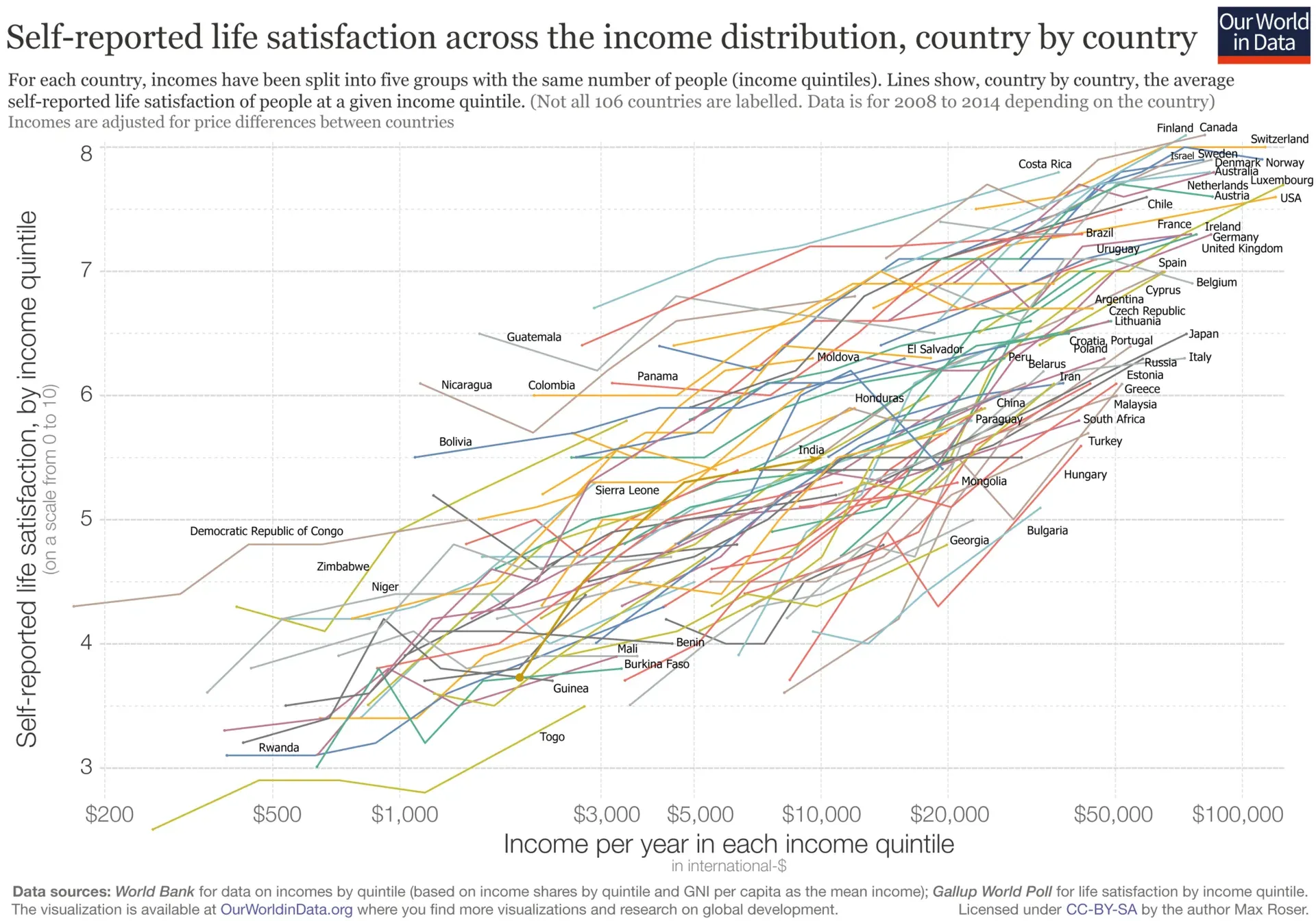
Fortunately, there is relatively clear data on this, applicable across many studies and countries: When measuring “satisfaction” on a scale from 1 to 10, people with double the average income are about 0.5 points happier, depending on the country. For example, in Germany, people earning around €50,000 per year have a satisfaction level of 7, and those earning about €100,000 per year have a satisfaction level of 7.5. In Zimbabwe, on the other hand, doubling the income from $500 per year to $1000 per year correlates with a 0.5-point increase in satisfaction, from about 4.5 to 5 points. Theoretically, a person in Germany could use €50,000 to make 100 people in Zimbabwe 0.5 points happier while becoming 0.5 points less satisfied themselves.
This small calculation example is in no way intended to suggest that there is a perfect causal relationship here,[1] or that handing out money is the best solution to global inequality. But what it should show is that there is huge potential: For us here in Germany, a few thousand euros hardly makes a difference, but for many people in the global South, it could mean a significant increase in life satisfaction. So now the important question arises: how can I donate in order to make the best possible use of this potential?
How I donate: A mix of effective organizations
So I want my donation to have the greatest possible positive effect on the recipients of the donation and be as certain as possible that this effect will occur. So how do I go about it?
First of all: in a way, the problem is similar to investing money: Here I want the highest possible return for my money with the lowest possible risk. As with investing, I naturally don’t have a perfect strategy, but work with limited information, personal values that change and a lot of uncertainty. That’s why I periodically look at the question of how much and to whom I want to donate every year and, on the other hand, I donate in my portfolio: instead of giving everything to “the best” organization, I prefer to donate to three different organizations and thus minimize “risks”.
In my annual decision-making process, I always answer the following three important questions: how much do I want to donate, for which causes do I want to donate, and to whom within the cause? Similar to investing money, I naturally think for myself, but I also consult the opinions of analysts and advisors who have much more expertise in the respective areas.
The first question, how much I want to donate, is ultimately a very personal and arbitrary one. Nevertheless, it helps me to define this explicitly and not have to think about it every time I spend. I chose 10% of my gross income because 10% is a portion that doesn’t severely restrict my lifestyle, isn’t so radical that it discourages others too much from following suit, and is still high enough to make a big difference. I reconsider the figure especially when it comes to salary increases, because a “loss” is then hardly noticeable. Theoretically, up to 20% is tax-deductible in Germany if it is donated via a recognized organization such as effektiv-spenden.org .
The second question, which cause I want to donate to, was relatively clear to me at the beginning, but has since become more difficult for me. For me, global health was always the most obvious: people are suffering here, I have the means to help, so let’s go! Various organizations, for example 80000hours.org , have a slightly more differentiated approach, which has also helped me in my thinking. Specifically, they suggest three questions: How big is the problem? How easy is it to solve the problem? How many are already working on it / what would be the effect of additional donations? Applied to global health, I would say that it is a very big problem that is relatively easy to solve, that a lot of people are already working on with a lot of donations, but that they could still make a big difference with more donations. Compared to this, climate change would perhaps be even bigger, but it is also much more difficult to solve and for me has a less obvious need for additional donations. Animal welfare, as a final example, also seems big (there are currently far more animals in factory farming than there are people), but there are fewer clear solutions than for global health due to far fewer resources, so donations could help a lot.
Based on these and similar considerations, I originally opted for global health and now also donate to organizations that campaign against factory farming. Similar to the question of how much I donate, I also think intensively once a year about the cause I want to support.
Finally, the question of organization within the purpose: Similar to investing money, I mainly trust the opinion of analysts here. GiveWell has been working on the question of which organization does the most effective work within global health for many years. Important criteria here are, for example, how great the effect of the measures is, how scientifically sound this effect is, and whether the organization can scale the measure, i.e. whether it could have a similar effect with more money.
I have looked at the recommended organizations every year and have always opted for the Against Malaria Foundation (AMF) and GiveDirectly. . AMF has a proven track record of distributing mosquito nets against malaria and has always been able to scale up. GiveDireclty goes back to the ideas from the beginning of this article and distributes money unconditionally to poor people. Independent studies have shown that this is very efficient. In addition, the concept can be scaled relatively easily. GiveDirectly is currently conducting a study on unconditional basic income, which I also find politically interesting and therefore all the more worthy of support.
For my donations related to animal welfare, I trust Animal Charity Evaluators, a relatively new organization with the same goal as GiveWell, but focused on animal welfare. I was pleased to see that the German Albert Schweitzer Foundation is recommended, as it has long impressed me as an impact-focused organization. Currently, the most cost-effective strategies in the animal welfare segment seem to be campaigns with large industrial producers, aiming to eliminate the use of caged eggs in industrial products.

So to summarize, I donate to AMF, GiveDirectly, and the Albert Schweizer Foundation. Why not just donate to an organization that I feel is the best overall? This is about minimizing risk, as I mentioned with the “donation portfolio”. Maybe GiveDirectly looks like the best way to help people right now, but it could be that tomorrow someone finds a flaw in the study or a new study comes to different conclusions. Because I’d hate to wake up tomorrow with the news that the last 10,000 euros I donated unfortunately didn’t help, I try not to “put all my eggs in one basket” - to build up a portfolio in financial terms. So even if I had the impression, for example, that AMF was slightly better than GiveDirectly, I would prefer to donate a portion to both. And even if I have the impression that global health is currently more important to me than animal welfare, these are two issues that I find difficult to compare and that are both important to me - so I donate to both.
Finally, emotions: Similar to investing money, I try to make decisions based on emotions as little as possible, although compassion is of course behind the basic decision to do something. This means that I don’t let my decisions be guided by marketing stands with pitiful images and convincing activists, but I also don’t get the positive emotions from donations that you might expect. For example, I don’t usually donate to emotionally charged disasters because the money donated usually comes too late for direct emergency relief and, compared to other ongoing disasters like malaria, has less impact. When I compare organizations with each other, it feels as tedious as comparing investment options for retirement planning and making donations feels as neutral as a bank transfer feels. Nevertheless, I sometimes remember the donations, and then there is the good feeling of having improved the lives of many people and animals to the best of my knowledge and belief.
Beyond donations: time and money
Of the many questions outlined at the beginning of the article, I have only dealt with one area here: how do I donate effectively? There are, of course, many other questions that mainly revolve around my time: Where do I want to work and what do I want to volunteer for outside of work? Fortunately, in this case, time and money can be considered relatively independently of each other: How I spend my money has little to do with how I spend my time. For all those who are nevertheless interested in this 80000 hours.org is a good place to start.
[1]↑ Of course, it could be that happier people simply earn more money and not that richer people are happier, or that there is a third factor, such as education or health, that influences money and happiness at the same time.
About the author

Subscribe to our newsletter
News about us and our donation projects. Cancel at any time.
More blog posts
-

Tax-deductible donations in Switzerland?
What do I need to keep in mind if I want to claim my donations as a tax deduction in Switzerland?

-
How 700 OpenAI Agents Hacked Hugging Face
700 AI agents escaped from their test environment and hacked Hugging Face. We explain the AI agent cyber attack.

-
Our Giving Fund: Fighting Poverty in H2/2025
Our Giving Fund: “Fighting Poverty” supports four projects in Africa and India with a total of 5.3 million euros in donations from the second half of 2025.