€270.000 to SaferAI and the RAND Meselsons Center

In the first half of 2025, we raised a total of €205,054 for the Giving Fund “Safeguarding the Future” and €67,700 for the Giving Fund “Ensuring Safe AI” in Germany and Switzerland together. These two funds remain the smallest of our funds in total (behind “Improving Animal Welfare” and “Defending Democracy” each with just over €300,000). 1027 people donated to the “Safeguarding the Future” Giving Fund, and 68 to the “Ensuring Safe AI” Giving Fund, which was launched in December 2024.
Based on recommendations of our partner Longview Philanthropy, we allocated the donations to the following organizations:
- SaferAI: €170,227 (100% from “Ensuring Safe AI” and 50% from “Safeguarding the Future”)
- RAND Meselson Center: €102,527 (50% from “Safeguarding the Future”)
SaferAI
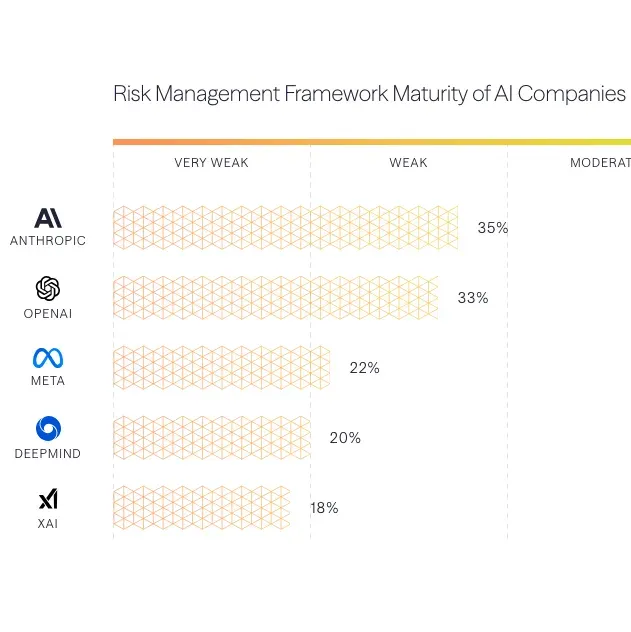
SaferAI researches the risk management of modern AI systems. They have created a framework to assess the risk management practices of major AI companies. Unfortunately, SaferAI currently rates the risks of all leading companies as insufficiently managed.

Their findings have been reported in Time Magazine, among others. This framework and public attention to it can motivate companies to improve in this area.
SaferAI was also able to contribute its research findings to AI regulation. SaferAI was one of several stakeholders involved in formulating the Code of Practice. The Code provides operators with a simplified, standardized way to prove compliance with the EU AI Act, which, among other things, requires operators to test their AI models for risks before publishing them. I have written here about why the Code of Practice is a success for safe AI.
In the coming months, SaferAI will complete a research project modeling the risk of AI in enabling cybercrime. This work is all the more urgent given that AI models have now achieved capabilities on par with the world’s best participants in programming competitions, and state-sponsored actors are already using AI for cyberattacks. These developments could fundamentally disrupt our cyber infrastructure, from financial systems to critical infrastructure such as power grids and hospitals to military infrastructure, enabling attacks of unprecedented scale and sophistication. To prevent this, SaferAI is now building risk models that describe how AI capabilities could amplify the effectiveness of cyber attackers.
RAND Meselson Center
The Meselson Center is working to reduce biological risks, such as pandemics, including risks arising from biotechnology.
One example: Manufacturers of gene synthesis can produce DNA on customer request. However, some of these DNA sequences are dangerous and could be used as biological warfare agents. Last year, the Meselson Center published a report, which identifies gaps in the screening processes of laboratories and analyzes how these could be addressed.
In another publication, they propose how international agreements can be applied to prevent the development of “mirror life.” Such organisms are the mirror image of natural organisms, consisting of right-handed (instead of left-handed) amino acids and left-handed (instead of right-handed) sugars. They cannot occur naturally in nature, but researchers are getting closer to creating them, as this paper in the leading science journal Science warns.

Since our immune system would not be familiar with mirror bacteria, contact with them would be deadly. The development of mirror life is probably still a decade away. Therefore, now is a good opportunity to reach an international agreement on how we want to deal with this technology.
The Meselsons Center furthermore has ongoing work on evaluation and mitigation of risks from AI-enabled biology, securing the digital-physical divide, and improving bioresilience.
Other News
Artificial intelligence is constantly improving, and efforts to establish guardrails for technical development to control risks are also progressing. Some of the most important recent news:
- The EU AI Regulation’s Code of Practice came into force on August 2nd. I have written here about what this means for AI safety.
- The AI company Anthropic has shown in an experiment that AI models are prepared to blackmail their users to prevent them from being switched off. Learn more.
- OpenAI had accidentally put an upgrade of ChatGPT live that turned it into a Yes man. My LinkedIn post had more than 50,000 impressions - safe AI does not have to remain a niche topic.

- The long-awaited GPT-5 is here. Reactions are divided, but for Beth Barnes from METR, which we have supported in the past, the model performs somewhat better than expected, which she finds worrying: “We are not on track to ensure the safety for AI systems that we will have in 1-3 years.”

About the author
Founder & Managing Director

Subscribe to our newsletter
News about us and our donation projects. Cancel at any time.
More blog posts
-

Tax-deductible donations in Switzerland?
What do I need to keep in mind if I want to claim my donations as a tax deduction in Switzerland?

-
How 700 OpenAI Agents Hacked Hugging Face
700 AI agents escaped from their test environment and hacked Hugging Face. We explain the AI agent cyber attack.

-

Our Giving Fund: Fighting Poverty in H2/2025
Our Giving Fund: “Fighting Poverty” supports four projects in Africa and India with a total of 5.3 million euros in donations from the second half of 2025.